Friday, May 27, 2011

Luxor; the baseness of Egypt.

Ah Luxor! This last step of our visit of the Egyptian oldies will not stay engraved in our memories only for the greatness of the temples of Luxor, Karnak and Ashepsut as well as the Valley of the Kings but especially by the level of baseness the Egyptians are ready to lower themselves to get money out of the tourists pockets. Of course, we’ve seen peoples of debatable honesty everywhere we went in the world but rip-off and manipulation are to Egyptians what manufacturing is to Japanese; large scale, efficient and inlaid in their culture and the social fabric like the roots of a willow in the ground. But before I give you more details I would like to specify that when I talk about Egyptians in this article I’m referring to the people involved in the tourist industry and not of the normal population. There are obviously honest Egyptians in Egypt, about 3 from the last census, but we didn’t meet them!


Luxor it’s obviously the temples of Luxor and Karnak as well as the splendid alley of the sphinxes linking them long time ago. Our hotel room gave on Luxor Temple with the Nil in background and since our visit was scheduled only for the afternoon we got the brilliant idea to go for a walk around the temple and along the River Nil. But the idea of walking peacefully in Luxor after the January revolution and consequently the collapse of the tourist industry was as brilliant as going hiking in the Canadian forest during mosquito season! But here the annoying bugs are the crap vendors and the boat tour operators that felt on us like a horde of Ethiopians on two walking steaks. In all, we managed to cross the record distance of 300 meters and being stopped every 3 meters by people simply not understanding the meaning of the word ``NO!``. Each interaction inevitably ending by an aggressive and firm rejection from us that would ruin the little pleasure we were hoping to have from the walk. After crossing 300 meters in a Herculean effort we gave up and resigned to hire a carriage and to ask him to take us for a one-hour ride away from any hassle. In the afternoon we were able to visit the two temples in the company of a guide without too much hassle.

The next morning was planned for the visit of the Ashepsut temple and the Valley of the Kings. Our guide was theoretically supposed to avoid us the usual hassles from the Egyptians but turned out to be the one trying to sell us stuff or asking more money then agreed upon. But in contrast with the street vendors he knew the meaning of a firm NO and would stop quickly. Despite the burning sun and the swindle try outs of our guide this visit of the West bank of the Nile turned out to be very enriching and we were able to wander around the majestic temple of Ashepsut that you can see on the pictures and in the Valley of the King where cameras were prohibited. The Valley of the Kings is a large complex of tombs with only a section opened to the public at any given time. Every three months or so they rotate the list of tombs the tourists can visit in order to reduce the degradation of the sites. This, of course, excludes the tomb of Tutankhamen opened at all time and for which we needed to spend an extra 100 pounds ($17) to visit. Even though the tomb is not particularly impressive we decided to go anyway to see the young pharaoh’s mommy and to be able to say that we entered the famous tomb, a thing we will probably never have the chance to do in the future.


While in Egypt do like the Egyptians do. Since we arrived in Middle East I wanted to get my hand on one of these long tunics men wear everywhere and seem to be called a jalabee or something like that. You can obviously find them in the tourist shops everywhere but they are of very bad quality and no local resident would ever wear them in public which would be equivalent to go walk in the street wearing a clown costume. With Mustapha’s help, our carriage driver who is as honest as a bank manager or a matrimonial lawyer, we succeeded in getting a custom made one and of very good quality. I wore it all afternoon and it was very amusing to see the faces of the Egyptians for whom a tourist is just a walking wallet wearing jeans or shorts with a baseball hat and a camera around the neck! But the jalabee alone was not enough to be completely like a real Egyptian. I also had to sell my soul to the Devil, eliminate any kind of respect for the other human beings, to learn to rip-off a person in every possible quasi-legal ways, to have no self esteem, to have no remorse harassing a tourist and bluntly lie to him right in his face as much as it is necessary to sell him a stupid crap with Egyptian drawings on it and this for 20 to 30 times the price I paid and finally to be able to sleep at night knowing that I am a thief, a swindler and a liar ready to lower myself as low as a used car dealer to get money from tourists. Finally, as it was to be expected, our ride with our national Mustapha ended up by a violent quarrel as he was asking five times what was agreed in the first place and we were just too happy to leave this town of thieves by the 5 O’clock train in direction of Cairo.

Monday, May 23, 2011

Aswan and Philae Island.

The second stop of our visit in Egypt was at the small town of Aswan about 800km (500 miles) south of Cairo. The place was relatively quiet, especially with the tourist shortage, and Egyptians would harass us almost in a humane fashion. There we could savor the Egyptian cuisine, modern or more traditional. Indeed at the end of our first day our guide took us in a Nubian village where the different dishes were served to us in ceramic or metallic pots and after the meal a group of children came in and danced and sang for us. It was obviously all organized but we let ourselves go at the rhythm of the drum and in the end had a lot of fun. To get to the village we took a small boat for a ride on the River Nile. Along the way we went through a narrower pass where an armada of boys sitting on their Styrofoam boards was waiting for us. Their plot was quite simple. When a tourist boat approaches they carefully position themselves on each side then grab the railing. They ask in what language we speak and then start singing a little song. I assume they know a song in each of the major languages and we were given a performance of “Il etait un petit navire” that would have chattered into pieces all the surrounding glass if we hadn’t been on a wooden boat! Obviously this was made in the pure Egyptian tradition which means that they don’t ask you if you want the song in the first place and after you have to give them money for their memorable performance. We then give them a coin but they look at you in a way to tell you that you are cheap and that it’s not enough and this no matter how much you give them in the first place! But they were only the Egyptian apprentices as the real pros were solidly waiting for us in Luxor!


Philae Island is the main attraction in Aswan where can be found the temple of the same name although it was originally located a little further down at a bit less than a kilometer of its actual position. It was entirely moved, brick by brick, to save it during the creation of Lake Nasser for hydroelectricity purposes in the 70’s, I think. It was really beautiful and very Pharaonic with nice sculptures on the wall and a very geometrical architecture. However, it was heartbreaking to see how many engravings were voluntarily damaged by religious devout of other religions finding offending the pagan ideas depicted on the temple’s walls. This was obviously yet another example showing how tolerance and religion don’t always go together! But beside the religious vandalism Philae allowed us to appreciate the scale of the post-revolutionary devastation of the tourist industry in Egypt. When we climbed on the boat taking us to the island we could see the hundred or so similar boats moored to the dock without work. In fact we were the only living souls when we arrived at the site. Believe me; it is quite impressive to be alone in one of the major tourist spot of a country. There is definitively no better time to visit a country than just after a good revolution!


Finally the two temples of Abu Simbel were the primary goals of our last visit in the Aswan area. The temples were lost in the middle of nowhere and getting there required a three hour bus ride then one hour to visit the temples and three more hours for the ride back. Despite the long distances to cover the visit was worth the trouble since the bus ride took place either along the Nile or in the Sahara desert. In the former case it was impressive to see how much people can pull out of the meager 200m or so of fertile shores along the river, the rest being just sand. The two temples of Abu Simbel are special not only because they are carved directly out of the mountain, which is certainly very impressive, but for the fact that, like the Philae temple, they were moved stone by stone by UNESCO at the creation of Lake Nasser! But in this case it was not only the fact they had to move the stones and the four magnificent statues of Ramses II but the workers also had to recreate a mountain behind them!!! A temple carved in a mountain without a mountain isn’t simply the same.

Sunday, May 15, 2011

Cairo; the greatnesses of Egypt.

Without a single exception all sailors visiting Egypt are in awe before ancient Egypt and totally disgusted by the Egyptians themselves! But in Cairo, a city of over 20 millions, it was the greatnesses of Egypt that greeted us. As for the Egyptian baseness’s we will talk more about them in our post about Luxor. Cairo is obviously the Great Pyramids and we wouldn’t miss the opportunity to go for the traditional camelback ride at the base of these 5000 years old monuments. It is even more impressive when we think that the Montreal Olympic stadium has a hard time holding 20 years without losing a 20 tons concrete beam once in a while! For those more attentive, it is fair to say they were in fact dromedaries but let’s not go there shall we!


Of course Cairo is not only the pyramid. We left Chocobo at the Port of Suez near the entrance of the canal of the same name and jumped into a bus to Cairo with the intention to take the train from there to the other points of interest, namely the towns of Aswan and Luxor. For our visit of Cairo we were in the good company of Gillian and Graeme who also left their sailboat Kathleen Love in Suez and with whom we sailed on and off with since our convoy in the Maldives. We then enjoyed a good coffee at the feet of the sphinx and the Egyptian Museum was also very interesting especially the section about Tutankhamen with the golden sarcophagus and all. The young pharos’s mommy wasn’t there though since it is in display in his tomb in the Valley of the Kings in Luxor. Of course one cannot go through Cairo without a short walk along the shore of the River Nile one of the longest in the world. Note that I say a “short” walk since it is nearly impossible to have a quiet walk there without the constant hassle from the street vendors and boat tour operators.


Beside the oldies we were also able to appreciate the unique charm of the city itself which is worth spending at least two weeks visiting. Unfortunately, time constraints being, we could only stay three days. Friends recommended us the City View hotel located directly in front of the Egyptian Museum and we decided to follow their advice. But what they forgot to mention is that the hotel in question also gives directly on Tahrir Square which is precisely where the main protests were held the month before leading to the fall of former President Mubarak. Tensions have calmed down since then with the militaries taking control of the government until the November elections but the population still maintains a continuous protest in Tahrir Square in order to maintain the pressure on the authorities. Thus we were able to enjoy a nice cold beer on the balcony of the hotel, located on the 5th floor of the building, while admiring the majestic museum and especially the crowd of the protest getting excited once in a while in front of us. The mood of the crowd was generally calm, no gunshots such as in Yemen, and we could even observe the street vendors taking advantage of the situation to sell hot peanuts and Egyptian flags at high prices. In the end the biggest impact these protests had on our time in Egypt was the total annihilation of the tourist industry in the country and consequently the tourist sites were virtually empty hence making the visits more enjoyable for us. However, all Egyptians living off tourism ended up with no customers in a matter of days and saw us coming like steaks in Ethiopia. Everywhere we went we were swarmed by the crap vendors assailing us like a horde of mosquitoes that, with their deficient English, had completely forgot the meaning of the word “NO”. However, if we were interested in buying something the negotiations were turning in our favor. Thus the price of a gismo would quickly drop from 15 Egyptian pounds down to 2 pounds after a few refusals from us!

Monday, May 2, 2011

Arrived in Turkey

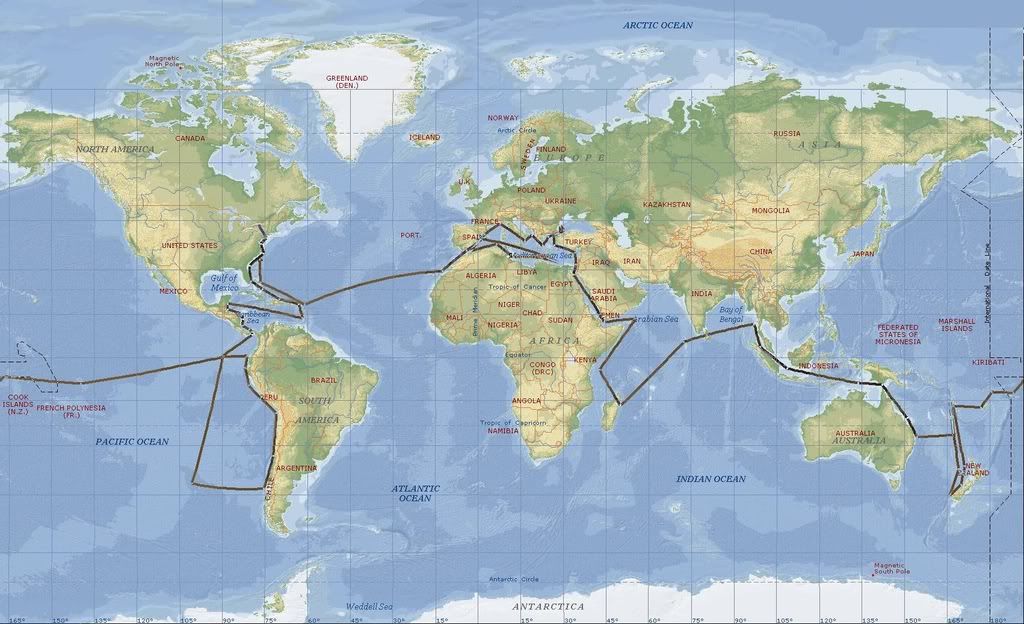
We arrived in the town of Kas in Turkey from Port Saïd in Egypt on April 26th 2011 after a passage of 329 nautical miles that took us 2 days and 14 hours for an average speed of 4.8 knots. This was our first sailing in the Mediterranean Sea.

Wednesday, April 27, 2011

Back in time in Sudan

When we arrived in the small town of Sawakin in Sudan we had the impression of having travelled back in time a couple of centuries for the people in this place sitting along the shore of the Red Sea live in what we would call “traditional” ways. We couldn’t say much about the rest of Sudan since Sawakin was the only stop we would make in this country and only for a couple of days, which is almost a shame but time being limited and the Red Sea having huge distances to cross we couldn’t afford to stay longer. Nevertheless, we still had time to go wander in the streets and the market to get some bread and other staple food we could find while walking between donkeys and camels used for carrying stuff around town. By the way, the flat pita bread they have here is the best we found so far. Probably cooked directly on a hot stone it tastes good and is dirt cheap which are the only two things you really want to know about it anyway. Details about the cooking, storage and transport are probably better left unknown! Of course as it would be expected in a remote place like this people don’t really speak English but are extremely patient and welcoming. In the market we took a few pictures and one of the merchant asked us for a printed copy of the picture. Having a digital camera it was hard to explain that we don’t print the pictures but keep them only on the computer. But back to the boat we remembered that we still had a few sheets of photo paper and printed four pictures and went back the next morning to give them to the people on the pictures. They were very pleased by this gesture but like it is the case in this part of the world they expressed their gratitude very quietly; a characteristic we started noticing in South-East Asia and which prevails up to here.


This picture shows what we would call the “Central City Water Facilities”. I could go on with sarcastic comments about the infrastructures of this town and the way they live but this would be disrespectful for this little community whose peoples try to make the best of what they have. Yes, water is carried by donkey carts and market goods sold on stalls made of a few planks or palm baskets but what can we expect in a country made of sand and shredded by years of civil war? From what we heard and saw Sudan is now politically stable and plan to split into two countries by next July or so. But this really seems remote events in the calm and peaceful town of Sawakin

Monday, April 4, 2011

The poorest countries in the world.

According to our Atlas published in 2004 Eritrea is the 4th poorest country in the world. So when we arrived from Yemen to the small town of Assab, Eritrea we expected the worst. There is no doubt that Yemen is poor but when you think that people run away from Ethiopia and, if they can, from Eritrea to get a better life in Yemen then this gives an idea of how desperate things can be in this West African country. In company of the crews of three other boats from our convoy we expected to arrive in the middle of an infomercial of World Vision with kids swamped by flies in their eyes and inflated bellies. But reality was quite different. Obviously, people here are not swimming in gold but they definitively have dignity. Assab was a town with low means but was incredibly tidy if not clean. No smells, no litters anywhere, people clean with humble but clean cloths. People as expected were very welcoming.


Eritrea just came out of a long war with its neighbor Ethiopia, of which it was part before its independence, and abandoned rundown buildings can now be seen everywhere. The exact justifications to why these two countries were fighting together are still fuzzy in our mind. You really need to land here to understand that there is nothing in this country. Normally, wars usually target the acquisition of resources of some sort but when I say there is nothing here it is not a metaphor. Everywhere we went, the ground was so arid that I think the only thing that can grow here is sand! Nobody makes a war for sand!!! Well, I assume they have somehow an idea of what they are doing and that they had very good reasons to make themselves even poorer by fighting each other. As a consequence the country and consequently Assab are not the most popular places for tourists and at our arrival it was made very clear to us that the town was very safe and we should walk the streets anytime with no worries. Of course the goal of having us to stay a few days in town wasn’t about the cultural enrichment travelers from all over the world could bring to them but for the money we would inevitably spend while probably paying 2 to 5 times the price normally granted to locals. But with that there was a small problem. Not on the prices themselves, which even at tourist prices things were relatively cheap, but on the fact that money is useful only when there is something to buy. As I said already there was almost nothing there so it was somewhat difficult to spend any money! Nevertheless, we still found a small bar where we had a well deserved beer. Well ok, we had a few more than one but this is really academic. The bar owners generously found us a nice and copious meal and even if it doesn’t look very appealing on the picture I can assure you it was very delicious and cleanly prepared. We are not sure what kind of meat it was though chances are it was goat meat. But anyway it was good and appreciated. Bread and meat were abundantly offered and it was obvious to us that even if we were paying a good price they were not products that easy to get by in this town. Also, when I say we were paying a high price I mean relative to what a local person would have paid for the same thing. At the end we still paid only $4.00 per person for a meal and 3 to 4 beers each! Really we can’t say it was expensive.


But even though we had a good time in Assab we had to keep moving north since the Red Sea is still about 1200 miles long. We stopped many places but the one worth mentioning was Mersa Dudo where we were able to visit the crater of an extinct volcano. The place was entirely empty but for the occasional passage of a few local fishermen who had a fishing camp on the shore. The landscape was so dead we felt like landing on the moon. Some trees of the type you see on the picture were growing here and there but otherwise it was only volcanic stones. Too bad we didn’t have a barbecue for which the stones would have been perfect. However, asking for burgers in Eritrea was maybe asking for too much. But we still walked around the crater by following the edge where it was so windy we had hard time breathing.

After a few days of island hopping we arrived in Massawa our last stop in Eritrea. Bigger than Assab the town had also suffered from the war. Around the port the buildings had seen better days and honestly the place must have been awesome before guns and grenades remodeled it. Again we were able to enjoy the Eritrean cuisine in good company even though it meant a mild gastric adaptation to the local bacterial fauna. But hey, we don’t travel all over the world to eat at McDonald when in West Africa are we? Food was interesting but people too. The government controls the population and we learned that people can simply not leave the country and god knows many would gladly go. We found it heartbreaking to see young men asking us to take them with us on board, without the government’s knowledge of course, to go anywhere as long as it is elsewhere. There’s maybe nothing for them here but to the point of being willing to leave their home and families to hope for a better life even if this means living illegally is something hard to hear. Obviously this was out of question for us to take them as stowaways so we gave them a few T-Shirts, watches bought at cheap prices in Singapore and a few packs of cigarettes and this made them happy. For lack of going to earn some money in exile they could at least smoke a good cigarette while wearing a T-Shirt with “I Love Singapore” written on it!


Despite the blatant lack of resources in the area we were nevertheless able to go to the market for provisioning. We stepped on a bus along with the crews of the other boats and as it is often the case the bus ride was as exciting as the place we went. We sure were squeezed a bit but as I said it already people here are courteous and clean. So no stench or any alike what we find in the buses during winter rush hours in Montreal! The market was after all well garnished with limited varieties but still with fruits and vegetables available. Bread was still a bit hard to get by. Flour is limited in the country and we were able to buy only certain breads while the others were for locals only. We also found an Internet Café but the government slowed down the transmission speed to and from outside the country to prevent the planning of rebel operations. The speed was so slow in the end that it would have taken us about 10 hours just to download our emails so we simply gave up. Like for the burger, internet in Eritrea was maybe asking for too much!

Saturday, April 2, 2011

The Gulf of Aden.

We left Al Mukalla early on February 24th, 2011 and set sails to cross the Gulf of Aden once the most dreaded waters in the world. Now, although it is not the safest place on earth, we were not as worried about this passage as we were in the Arabian Sea. On the other hand we still had to be careful as Danielle and I had to remind everyone once in a while during that passage such as this afternoon when we had to stop for about half an hour for one of the boat to fix his transmission. It was sunny, hot and the sea very calm. The crews of two boats then decided that it was a good opportunity to go swimming! In normal places that wouldn’t be a problem but a calm sea in plain daylight and in the middle of the Gulf of Aden constitute ideal conditions for a pirate attack! But after three weeks of being on our guards at all time we just reached the point where we simply don’t care anymore. Things went pretty smooth but it was very tiring and we took a bit more than three days to sail the 400 miles or so between Mukalla and Bab El Mandeb, this strait marking the south end of the Red Sea. Once in the Red Sea, which is now considered pretty safe to yachts, it became clear that everyone was stretched to their limits of sailing in close formations. After sailing 16 days and 1900 nautical miles together it was time to split up now that the conditions requiring a large convoy were no more present. We then said goodbye to each other and split into two groups. Four of us decided to stop immediately in the town of Assab, Eritrea while the other five boats wanted to take advantage of the strong southerly wind to make a good way north and kept going.


This was the end of an incredible adventure we’ve had shared together and that would stay in our memories forever. Together we sailed through the most dangerous waters in the world and prevailed, maybe by sheer luck, or maybe not and if this trip together was over our friendship was definitively not. We would necessarily meet along the way North in the Red Sea and when this happens we will not simply meet with other boaters; we will rejoice with dear friends.

In the past few articles of this blog I told you our story of how we sailed through the pirate infested waters of the Middle East and how we made it safe and sound to the Red Sea but I didn’t answer the one question all of you must have in mind when reading this; Why in the world did you go through this hellish area in the first place? And this would be a very valid question since we could have decided to sail directly from Australia to South-Africa or to forget about this stupid idea of sailing around the world altogether and just stop in Australia or stay in the Caribbean Sea like so many others do. Well the answer can be summarized in one word; freedom. We all try to do the best of our life. We work, we raise our kids and we try to make our life worth something. But in the end, one day, we will be dying and we’ll sum up what we’ve done of our life. We’ll ask ourselves what have we done that was unique, that was really us? Not something imposed by others but really chosen by us. All our lives are mostly dictated by others. The government tells you how to work, how to raise your kids or how not to die from smoking. Even when you decide to jump on a boat and go around the planet the tourist industry tells you what you must see, the authorities makes things expensive for you, the weather tells you when you move and when you don’t and the pirates tell you where you can sail or not. Where is freedom in all this? The goal of this trip is not about travelling around the planet and crossing all the meridians; it is about the trip itself. If your goal is to travel around the world then all you need to do is to buy airplane tickets and in less than a week it will be over. We are living what many only dream of. We are achieving something unique, something we decided to do even though everyone and everything is against us. We wanted to see the world and to decide how we do it; to do it our way. Not the pirate way. Yes we had the choice to either chicken out by sailing around Africa and missing all these amazing countries or to say “No! That’s where we want to go and that’s where we are going!” What you do with your life is always a matter of choices and we made ours.