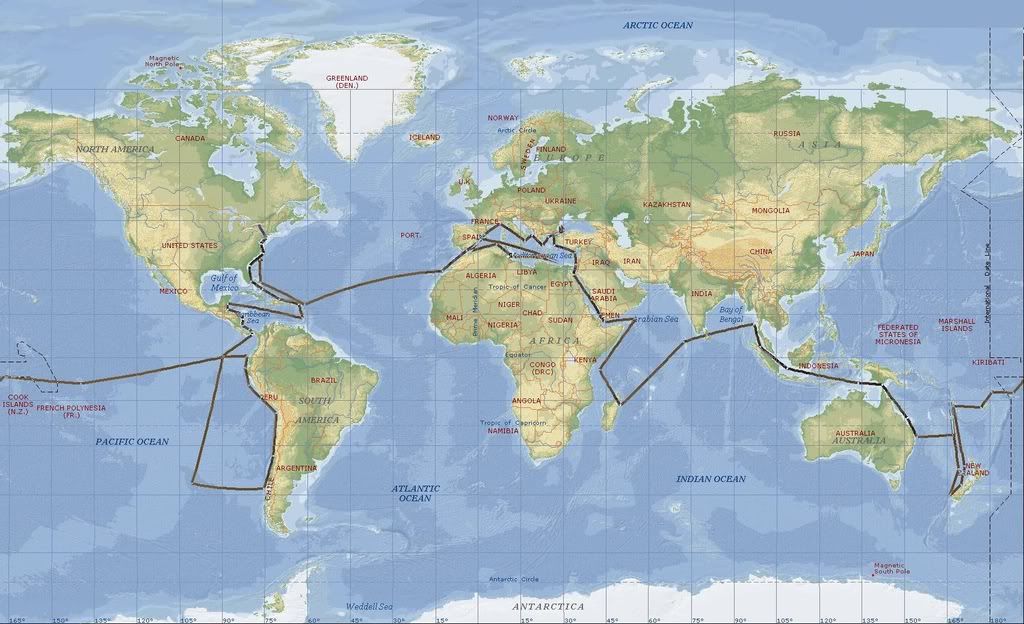
Tuesday, December 28, 2010

The Beach.

If I tell you we can find Ma Ya Beach on Phi Phi Leh Island in Thailand this may not ring any bell but if I say “The Beach” featured in the movie of the same name starring Leonardo DiCaprio then it may be a different story. The movie is a bit old, it came out in 2000, but quite good so, if you haven’t seen it yet, go to the video store and rent it. We indeed went to that paradise beach and were wondering how in the world did they managed to empty it from the 500 or so tourists visiting the beach every day! Chances are that the tourist rush significantly increased after the movie came out and the place became the major economic drive of the area. We were maybe not on a deserted island lost in Asia but the place was still one of the most beautiful scenery we’ve seen so far; crystal clear water and powdery fine white sand you find nowhere else.


We couldn’t go with Chocobo as the bay is relatively small and shallow so we did like everybody else and moored at the neighbor island of Phi Phi Don and hired one of these Long Tail Boats who took us at Ma Ya Beach as well as other places around the island. Of course the name of the boat comes from the long propeller shaft that allows them to maneuver in very shallow waters. We walked a bit on the island but unfortunately the scenes of the village and especially the ones in the marijuana field were shot somewhere else as the island is made only of high peeks surrounding the bay with barely any flat area. We so much wanted to see … the village! As for a shark attack you need to actually go somewhere else to get one as the local reef sharks are as dangerous as a cow in a hay field. By the way, the name of the island, Phi Phi Leh, is pronounced “pee-pee-lay” and no I’m not kidding!

Thursday, December 16, 2010

Arrived in Thailand

We arrived in Pulau Bunting, Thailand from Kuah, Langkawi, Malaysia after a bumpy ride of only 25 nautical miles but that was good enough for one day in those conditions. We are on our way to Phuket, Thailand where we will proceed with our official clearance in the country. To get to Phuket we need to do day hoppings by jumping from one island to the other and anchoring during the night since sailing overnight in the area is nearly impossible.

We love fishing nets in Malaysia

We are on our way along the Malaysian coast through the Strait of Malacca and unfortunately we don’t have much time to visit this part of our route. We must be underway every day that the weather permits it and since we can only sail during the day our progress is very slow. Two reasons prevent us from sailing during the night. The first reason is the weather and every evening or so we get severe thunderstorms which are really not ideal while sailing in pitch dark! But the main reason is the Malaysian fishing fleet. Fishing boats are everywhere and we need to have a very close watch while on the way to avoid them but mostly their fishing gears. On the picture you can see a large fishing boat with a huge floating net, these are easy to deal with as they move slowly and the nets are pretty obvious. The problem for a sailboat comes from the small ones. These little wooden boats, about 25 feet in length, drop nets staying just below the surface and are fishing everywhere by dozens. You really don’t want to be a fish in the area that’s for sure. They also leave hundreds of fishing cages scattered everywhere and marked only by a little flag and when I say “little” I mean it. In fact the flag is usually made of a small wood stick floating on 2 plastic bottles and mounted with a square flag that so deteriorated that they look like the surrender white flags during the Napoleonian wars after two weeks of battles.


But the best story happened just after we left Pulau Bunting an island that offered us a good shelter against the daily thunderstorms prevailing in the area. In front of us was a line of fishing boats, maybe 20 of them, all seeming to fight for the same school of fish. We proceeded cautiously trying to evaluate the erratic driving of the fishermen and to stay as far away from them as we could. At one point one of the boats came in our direction and turned at the last minute to pass us at our stern. We were at that moment motorsailing, which means that one engine was running but both sails were fully open and even though the wind was weak we were still sailing and our maneuverability very limited. As I was looking at the fishing boat passing just right behind us one of the fishermen then pointed ahead of Chocobo urging me to look. Another fishing boat was sailing at full speed toward us at angle and I had to put the engine quickly in neutral to avoid a collision. Putting the engine in neutral significantly reduced our speed and was enough to let the fishing boat pass but we were still sailing full sails open! I was looking at the boat sailing away from us and wondering what exactly this guy was doing. In less than two seconds the horror jumped at me; they were dropping a fishing net!!! The bunch of morons passed at full speed right in front of a sailboat and dropped their 300 feet (100m) long net. Of course we caught the net as we were yelling at them to stop and not to start pulling the net. Danielle rushed to lower the sails in order to stop the boat but without turning the boat into the wind this can be quite a challenge. Nevertheless, she managed to do it while I was trying to spot the net and see where it was tangled. The fishing boat came behind us as we were trying to assess how the net was tangled and how to release it. One of the guys on the fishing boat shouted to us to put the propellers in reverse. Of course, how come I didn’t think about this myself? The best thing to do when you have a line tangled in your propeller is to spin it even more! Geez how can someone be so stupid and yet be allowed to breath. Then another of the geniuses on board suggested that we cut it, and of course was oblivious of the fact that this net was what would bring the food on his table the next week. But by then Danielle and I had had a couple of minutes to assess the situation and at the same time we said “we have to dive!”. I was quickly putting my swimming suit and grabbing my mask and snorkeler while Danielle was setting a line for me to hold in case there was a current under the boat. I jumped and fortunately the net’s top cable was simply sitting on top of the propeller blades and all I had to do was to release it from the two propellers and free we were. We waited a minute to let the net sink and to be sure it was out of range, waved goodbye to our bunch of monkeys on the fishing boat then engaged the propeller and off we were. Now, the exact reason why the guy went dropping his net right in front of us is still unclear but the fact is that this happened in a region that was well known for piracy not so long ago and the fact that pirates attacking the small yachts were usually fishermen trying to round up their ends of the month a little! Well this struck me only way after the events and honestly we never felt treated in any way during the whole time; we only felt victims of blunt stupidity!


During our day hopping we stopped for the night in Port Klang, Malaysia, which appears to be probably the largest cargo port in Malaysia. It was far from the dimensions of Singapore but still quite impressive. Have a look at the large container ships being unloaded by the giant container cranes. I am sure you didn’t think it was possible to fit that many containers on a boat hey? Note, by the way, that the containers are simply sitting there untied on the ship. What do you think happens when one this big guy gets caught in a huge storm? But again the best part came later. Just after the first docks we turned into a side river and anchored in what appeared to be the stinkiest place we’ve ever anchored. The stench was so bad that Danielle had a hard time to sleep while I slept like a baby. Apparently, I have no problem sleeping over a dump. Obviously, the smell was coming by the untreated sewage waters released by the surrounding industries and towns not caring much about that costly concept of environment protection. Note however that Malaysia is poor, very poor and talking about environment protection is easy from a guys coming from a country where the average family revenue is about $60K/year! Anyway we had no choice but to stay there since it was sunset and we had no time to find another place to anchor.


The only place we really stopped in Malaysia was the town of Kuah on the Island of Langkawi where they somehow erected a giant statue of an eagle as the main landmark of the very crowded but also very roomy harbor. We took a few days to stretch our legs in the city streets and markets since we hadn’t go ashore since Puteri eleven days ago and all our muscles started to feel like jello! Of course, we enjoyed the delicious and very cheap food the many restaurants had to offer. Indeed, with $7.00 to $18.00 for the two of us we could enjoy Thai, Indian or Malaysian meals that mix curry, ginger and chili in ways only Asians can do. We also went to McDonalds once but to our defense for this culinary offence in this kingdom of spices, which is South-East Asia, I must say that we were on a hurry and just went for what fast-food stands for! Another aspect of our life in Indonesia and Malaysia is the daily Muslim call for the prayer. I don’t know if I mentioned it before but Indonesia is the largest Muslim country in the world. Bali may be mostly Hindu but the rest of the country is definitively Muslim and Malaysia is the same, just smaller in population. This beautiful mosque happens to be very close to the shore and like every mosque they have loud speakers to make all the followers to hear the prayer, which as you know happens five times a day. I am not sure if the call is made in Arabic or in Bahasa but it sure sounded Arabic to me. Nevertheless, if you never heard a Muslim call for prayer before let’s say that it sounds like a long song where words are stretched in a slow and harmonious complain. One thing about this call from the mosques is that we are not sure exactly how they chose who sings in the speakers. Here in Langkawi the guy from the nearby mosque was quite a good singer and Danielle and I enjoyed hearing him every day. However, in some remote islands of Indonesia the Imam or whoever was yelling in the microphone from the temple sounded more like an old rooster with a hangover trying to still impress after it was long overdue! I mean, seriously, some were so bad that it would be a valid reason for the entire village to change faith just to stop hearing the guy five times a day!

Tuesday, December 7, 2010

Arrived in Malaysia

We arrived at Puteri Marina in Malaysia after simply crossing the Johor Strait from Singapore, a short 7 miles ride. We stopped here simply to clear in the country and to refuel before attacking the Strait of Malacca as the fuel is much cheaper in Malaysia than Singapore; $0.83/liter instead of $1.09/liter. Our plan is to day hop from here to Langkawi, Malaysia through the Strait of Malacca, which is well known for two things; pirates and no wind. The good news about pirates is that this was mainly an issues in the 80’s or beginning of the 90’s and involved mainly large cargo ships for which large ransoms were demanded. Singapore, Malaysia and Indonesia joined together and seem to have cleaned the area so we are not too worried about that. Anyway after all boat expenses we had in Australia and Singapore we could maybe pay them $3.96 for our lives since this is about what we have left in our pockets. Oh wait, even better we will give them the boat so they will become totally broke after a few months of trying to keep it in working order! As for the wind, as far as we know, the authorities have not done anything about that ;-) so we will have to motor our way up toward Thailand but since fuel is relatively cheap in the area it is no biggy.

Monday, December 6, 2010

A glimpse of Singapore.

Although we spent over 11 days in Singapore we didn’t do anything special really. We first started by getting a new refrigerator unit and replenishing our meat since we lost most of the one we bought in Australia. But the very day we got the new unit in place we decided to have a quiet evening and just sit down to watch a movie. Danielle turns on the TV but oh surprise the screen stays black! We tried another time, then another, no success the nice flat screen TV we bought only 2 years ago had died probably by suicide to relief itself from the unbearable heat and humidity level of this area of the world. So we went all over the city to find a new television that would actually fit in the enclosure we have for it, that would work on 120V and support NTSC, which is the signal encoding standard in North America because of course in Singapore and in most of Asia the power voltage is 240V and the encoding is PAL! But don’t worry, if we could find diesel in Benoa we can find a TV in Singapore!

So off we went in this Mecca of shopping which is Singapore. Jurong Point, Sim Lim Square or Orchard Road now have no secrets to us. It is simply impressive how many shopping centers this city has and this really made us wonder who in the world buys all this stuff? Anyhow, we found our TV and other stuff we needed and cannot be found anywhere in the underdeveloped surrounding countries. But Singapore is not only about shopping it is about eating. Food is everywhere and it is cheap; usually under $10 for two meals! We filled up our refrigerator but it was really cheaper to eat outside especially with meat being quite pricy at the grocery store. Danielle sure enjoyed the local food but at one point just needed to go back to “occidental” food such as fish&chips and club sandwiches. As for me, I just couldn’t get tired of noodle soups, mee gorengs (fried noodles with tons of stuff and spices in it), dumplings and all the good stuff Asia can offer.


Singapore is obviously a clean, developed and modern city and one if its beauty is the subway or MRT as they call it, which is a very modern rail system running over and underground. Public transport is the always the best place to take the time to look at what people look like and Singapore appears to be a very cosmopolitan city with mostly slim people coming from all over Asia mainly China but also Indonesia, Malaysia, India and all the other countries finishing by “a” in the region.


Other than sinking our retirement fund with refrigeration units and TV sets we also wanted to see what Singapore had to offer to tourists. We sure went to Little India, Chinatown and the Colonial district to admire the unique architecture but there are two things we didn’t do and wanted to. The first one was to see the city at night, which is apparently quite unique. But what the travel guides forget to tell you went recommending visits is that in Singapore in the evening it rains! No I should say it pours in biblical proportion as if the heavens had suddenly liquefied and decided to fall on the city all at the same time! When it rains here you can literally take a shower, which I actually did once on the front deck of the boat! So, needless to say that our trial for a night visit was washed away by the weather. The second thing we wanted to see was the Singapore Zoo but again weather was not with us. As we arrived at the MRT station for the zoo the rain was rumbling the city like the Niagara on the tourists in their tour boat. We simply stayed in the train and stepped out in Chinatown, which is actually quite a paradox. You see, Singapore is by a large majority populated by Chinese immigrants who came here over the last centuries. Therefore, can anyone explain to me what does a Chinatown mean in a Chinese city??? After that I am certain that if we even go to Beijing we would find a Chinatown district!

Here you can see Chocobo moored at Raffles Marina and behind is the majestic replica of a true Spanish galleon called Andalucia with guns and all who just arrived a couple days after us. This boat was by far the most beautiful boat we saw during our trip. Here you can see Danielle changing the line holding the trampolines at the bow and we were amused to see that during the whole week Andalucia was beside us the entire crew was buzzing doing what? Fixing their boat of course, this is obviously what the sailing life is all about!

Saturday, November 20, 2010

Crossing of the Singapore Strait.

Danielle dreaded arriving in Singapore since the beginning of this trip for a very simple reason; Singapore has one of the busiest maritime installations in the world and sailing in these waters with Chocobo made us feel like being a chicken in a herd of elephants. Seeing a supertanker is a very impressive but rather rare event when sailing around the world. But here it is not one but over a hundred of these behemoths we found maneuvering or anchored along the 40 km or so of the Singapore waterfront all of it filled up with docks or refineries. We show you here some pictures but I really don’t think you can feel what it is like without being physically here yourself. The place is huge, immense, gigantic! In fact, the engineering feat of building such a group of installations is so titanic that I wouldn’t probably believe it if I hadn’t seen it with my own eyes. In many places they reclaimed the sea to create more waterfront length for the cargos. The new lands cover many square kilometers and were claimed over 100 feet (30m) of water. Can you imagine the amount of rock and sand they needed to carry to do that???? And I am not talking about the docks and cranes everywhere required to move the containers around.

But let’s start with the beginning. We were in Batam, Indonesia and all our efforts to fix the refrigerator were unsuccessful so we had to go to Singapore, more precisely at the Raffles Marina on the western side of the island as it is not possible to anchor in a convenient place anywhere in Singapore. Only about 8 miles separate Batam from Singapore but those few miles represent the Singapore Strait. The fact is that all ships sailing from the Middle East or the Mediterranean Sea to Asia must go through the Singapore Strait and this makes this narrow channel looking like a highway of super cargo ships and supertankers. Being in such a strategic location it is not surprising that Singapore developed an impressive array of oil refineries and maritime installations. Our first goal was to cross the channel to get on the Singapore side. This is not very complicated but it has to be done with care unless you want to end up crushed by a ship so huge they would probably not even noticed the impact. We chose the narrowest spot of the channel and literally looked on both sides to make sure we could cross without interfering with the continuous traffic going on in both directions. The crossing itself took about 20 minutes with the engines running at maximum speed (we were making 7.5 knots!) but there was a ship every 12 minutes on each side! We timed our crossing carefully and we didn’t make the front page of the newspapers the next day. Once on the other side we entered the Singapore harbor, which is an amalgam of anchorage areas for the cargos and fairways for them to move about. Note that in a world of giants an ant like us has no rights of way whatsoever and all the responsibility of maneuvering safely falls on us. But since in this area the vast majority of the ships were anchored and even if they were of titanic proportions it wasn’t too difficult to avoid them and move about. At mid distance to our destination we had to stop to clear in the country with immigration. Usually, when entering a new country, it is necessary to stop at a given location and go ashore to see the local authorities for the clearance but here they came up with a much more efficient way of doing business. Arrived at what is called the western anchorage we called immigration on the VHF radio and announced our arrival. They told us to stay put and wait for them. The anchorage is 26m (80 feet) deep, which is too much to drop the anchor, so staying put means floating around and wait. But we didn’t wait much since as soon as we arrived at the rendezvous point the immigration boat was already there. They came by us and pull a net at the end of a pole and asked me to give them our passports and three copies of the crew list. I put the documents they asked in the net and then we waited about 5 minutes for them to process the papers. They came back with the net and a form I needed to sign, which I did, and then they gave us our passports back along with our clearance paper. Everything from beginning to end took less than 10 minutes and we were on our way!


But at this time we were already too late to cover the remaining 20 miles and reach our marina before sunset and had to find a spot to anchor for the night. The western anchorage was already ruled out because of the depth and anyway who in his right mind would like to anchor for the night in the middle of 30 supertankers, seriously? A few miles west there were a few islands and shoals in which we found a nice spot to drop the hook in 20 feet (7m) of water and safely spent the night out of the way of the ships and who knows what. All around us the waterfront was occupied by refineries and these installations don’t stop during the night. We had no smell as we were windward and no noise but instead could witness something impossible to see but from the water. A refinery somehow needs lights all over its pipes and towers, pretty much everywhere and with 10 km or so of refineries around us after sunset we had the impression of being in the middle of Christmas tree! Sorry our camera cannot take night shots like that because of the slight movement of the boat during the one or two seconds of exposure it requires. But take my word for it, it was a scene we are not about to forget! The day after we continued our way between the enormous ships, which were defying the reason but yet respecting Archimedes’s principle, in our Lilliputian boat and made it safe and sound to our berth. While on the way I estimated that there were about 150 ships anchored in the Singapore area. When we crossed the Panama Canal we were impressed by the 50 or so cargos that were waiting at both ends but here we realized that this was merely a maritime sand box. Singapore is the yard of the grown up and in fact I am pretty certain that most of the behemoths we saw here are too big to even go through the Panama Canal!

Wednesday, November 17, 2010

Arrived in Singapore

We arrived in the nation city of Singapore from Batam in Indonesia, on November 11th, 2010 after a passage of 24 nautical miles (45 km) that took us just a few hours. In fact Batam and Singapore are so close we can see one from the other assuming we can see through the stream of super-cargos crossing the Singapore Strait! What makes this arrival in Singapore special is not the distance covered but the crossing of that strait and the port of Singapore. This is one, if not the, busiest port in the world and crossing the Singapore Strait must be done with care. First we got to our crossing point where the channel is the narrower, and then we looked on both sides and put the throttles to max speed and crossed the main ship channel at right angle. But this was just the beginning of the fun. Once on the other side we had to manage through the 50 km length of the Singapore maritime facilities but I’ll talk about this only in my next post…