Wednesday, March 24, 2010

Galapagos

Today instead of being Roger writing the post it will be me. Roger will be very busy for the next couple days doing something else. I’ll tell you what later.
First, let’s start with the wild animals here in Galapagos. There is a lot of wild life and we couldn’t see them all because we would have needed a lot more time than the 20 day visa we obtained and we would also need a lot more money as well. They do have a kind of penguins that we couldn’t see other than by taking a 2 day tour at $ 200.00 each so we passed on this one. Here you can see the swimming iguanas, unique to the Galapagos, and incredible red crabs wandering everywhere along the shore. By the way the Galapagos are volcanic islands and this is why the rocks are all black like this.

But really one doesn’t need to go on a tour to see animals here. Everywhere from the railing of the boat to the branches of the trees you just need to look to start seeing birds of all kinds. Pelicans, which are common everywhere outside the Galapagos, mocking birds or other one we cannot name are here to be photographed.


When I was 26 or 28 years old I went to Bermuda and took a dive tour without having any certification. We had to dive down to 30 feet (10m) and the instructor told us on the boat, while we were going to the dive site, a few little things we had to know such as signs underwater. A 20 minutes explanation and splash we were in the water with a tank on our back. I liked it very much and when we arrived in Galapagos they offered us a diving tour to go see hammer sharks, turtles, and some other wild life. We asked to do the tour a little later and the guy asked us what our diver certification level was. We looked at each other and answered “Well, none!“. Then he replied back “Well, you can’t dive then”. That’s when we decided to take the PADI certification. Roger and I went last Friday to do the first day of the open water course. We had an instructor for each of us. After we put all equipment on our back, which weighted about 2 tons, tank, suit and all he told us to walk about 5 feet on the pier and jump into the water WOW! Anyway, we successfully did it. I don’t know how though. We went down about 20 feet deep and the exercises started. First my instructor gave me the sign to remove my regulator from my mouth euh, what? Euh? Right now? Well, a moment please, ok I thiinnkkk that I am ready. Voila!, the regulator is removed and hanging somewhere behind my back attached to the tank. Now I have to retrieve it and make bubbles from my mouth all the time while the regulator is out, put it back in my mouth, blow in it, and finally breathe. Oh! Oh! No air left in my lung to blow the water out of the regulator!! I made the sign indicating I have no air (the sign looks like I will cut off your throat if you don’t give me some!) and another sign that I am going at the surface RIGHT NOW! I started swimming toward the surface. Half a second later he grabbed my leg, pulled me back down and, in a second, plugged his second regulator in my mouth, WOW! Air again. That was weird but hey, I had air again. I can breathe underwater! During the next 40 minutes we practiced many things of the course such as filling my mask full of water and emptying it with my nose. That was not so bad. In the afternoon, we had a second dive. This time he added 2 more weights to my belt. I will never be able to come back at the surface I thought. I am done, I will drown. I could barely stand with it. Now, jumping in the water and start descending oh! oh! Can’t breathe! I felt like a queen, you know with these corsets around their waist. I CAN’T BREATH! I’m going to the surface but this time I was only 2 feet deep so he couldn’t stop me ha ha! Even at the surface, I couldn’t breathe! The instructor calmed me down since I was obviously on stress, and he said ok we will not do the course today we will just learn to relax and swim and enjoy the dive. We then went down for about 40 minutes without any other incidents. The water in the morning was clear but in the afternoon it was so murky that we couldn’t see 5 feet ahead of us. He said that I panicked because of that. When the water is blurry like that it takes about 3 days to clear again. We will then wait 3 days before continuing the course. The problem is the visa is about to expire and the weather was good to leave in 3 to 4 days. To finish the course in these few days, we will have to dive twice a day. NO WAY! This is way too fast for me, I need more time. I then decided to stop the certification and take it again later when we have more time and clear water. This is why Roger is busy. He has to finish it by himself :-(


Although most tours are very expensive in the Galapagos we found one that wasn’t too bad and went to see a turtle sanctuary where 100 years old Galapagos turtles are protected in order to try to get their population up again. Here we had a lot of fun. We arrived at the time where they feed the turtle with these large leaves and since they are used to the human presence we could feed them by hand. They were quite funny to see snapping into the stem of the leaf in a rapid movement of the head coming out from under their carapace. By the way I put a video of this in our video section for you to see. It would have been nice to pet them but honestly a cat is much smoother than a hundred years old turtle! Not to mention that after seeing how hard they can snap through their food we found wiser just to not touch them altogether!

The animal we liked the most was the sea lions. Let me explain why. When we arrived on March 10th in the anchorage we saw a catamaran with a couple of sea lions on their steps so we thought “This is so cute”. We then put the anchor down and proceeded to check in in the country. As soon as we came back on the boat, we started looking for sea lions if any of them were lying on our boat. What a deception when we found none. Then at night 2 of them climbed on the boat and installed themselves comfortably for the rest of the night. We thought, “Oh! They are so cute with their big brown eyes and their big noses they really look like big puppies”. We did everything to not disturb them and made sure they stay. In the morning we had about 5 sea lions lying on the steps, on the deck and even one in the cockpit comfortably installed on our cockpit cushions. That was magic. I said to Roger “Leave them there, they are so cute and they can’t put dirt anywhere since they are coming from the water they are clean anyway”. We left the boat to go explore the island and came back only at the end of the day. What a surprise! During the day, with the hot sun, they started to dry and the nice smooth skin changed for a big fur shedding everywhere on the boat. That wasn’t all, they were so comfortably installed that they didn’t want to leave the boat when they felt they need to go to do their thing so they simply pooped everywhere (and we are talking about 200 to 300 pounds sea lions here) they rolled all day long in it and crawled all over the boat dragging and spreading their stuff under them ARKKKKK!!! We started to raise our voices “GO OUT! GO OUT!” until all of them were back in the water. Ok now we had to scrub the entire boat for about 2 hours. After 2 hours we gave up since the boat was stained all over. We start looking to other boats and noticed that all of them had big pile of fenders in their steps preventing the nasty poopers to come aboard. We then piled all fenders and jugs we had on the steps. Good, none of them climbed the following night and the next day. The night after though we heard a big bang around 2:00 am. We rushed outside to found a huge sea lion on the deck. It was there for probably few hours because it had done all its needs on the deck. Brown disgusting stuff was everywhere again. Roger and I started to scrub all over again in the middle of the night. The day after we added ropes to all the jugs and fenders and were glad to see that no sea lions were climbing anymore. Well for two days at least. Every couple of days, they found a new trick to bypass our huge pile of stuff, that was growing every 2 days and getting more and trickier to go through, and to climb again. We scrubbed the entire boat every 2 or 3 days for a large part of the time we stayed in Galapagos. Roger said “I am sure they have meeting every morning all together to discuss new tricks on how to climb through the new setup“.
Don’t get me wrong, They still are cute and social animal as far as they stay in the WATER!


To conclude with Galapagos, if you really want to see it, the best way is to take a cruise of 4 to 7 days and they will take you to each island. If you come with a sailboat like us, you are not allow to move your boat anywhere so you have to take tour boats to visit islands which is very expensive. The reason is that they want to protect the environment and maybe a little bit to create employment who knows…

Monday, March 15, 2010

Arrived in Galapagos, Ecuador

We arrived at Puerto Baquerizo Moreno on Isla San Cristobal Island in the archipelago of Galapagos at 12:11 local time after 149 hours at sea. We sailed most of 880 nautical miles trip, which took 6 days and 5 hours.

Panama to Galapagos Crossing

When we left Isla Bayoneta in the archipelago of Las Perlas in Panama on March 4th, 2010 we didn’t completely knew what to expect of the 880 nm (1637 km) crossing ahead of us that would take us to the legendary Galapagos Islands. Of course we had read everything that has to be read about this crossing and did everything we thought was necessary to prepare the boat and ourselves to avoid any trouble but the fact is that our longest passage so far was 300 nm and took only 56 hours. The key point here is weather prediction. Usually the wind forecasts are relatively accurate for up to three days and since all our previous rides took less than three days we were able to have a good picture of what to expect along the way before we departed. All we had to do is to wait for the proper weather window and leave at the right time to have favorable wind and waves for the entire trip. But this passage we were facing now was to take at least 6 days and there are no weather forecasts today that would give us a reliable picture of the wind six days ahead of time. Well it gives you a forecast for about 8 days but that may change really fast, the first 3 days are usually accurate. The other major unknown factor was the time it would take before we can anchor and have descent sleep. We knew we could manage to sleep two or three hours at a time between our watches for two days but how about 6 days? How about 3 weeks that it will take us to get to French Polynesia after the Galapagos? Are we going to be able to cook along the way with the waves and all? Many questions we knew the answers from the books we read but this is the kind of things you cannot answer by reading books but only by living them yourself. But the unknown is intrinsically part of this journey and like we did every day for the last year and half we would face it and address any situations as they arise along the way. We did it in the past and frankly we were quite successful at it so we had a good level of confidence in ourselves and the boat as we were motoring to clear out the island and position the boat in the proper direction with the wind right behind us.
Danielle had carefully chosen our weather window after analyzing the local wind patterns for the past month while we were preparing in Panama. According to the forecast there was a strong northerly wind system coming up in the Gulf of Panama and would stay there for at least three to four days or maybe more. Our plan was to leave as soon as the system starts developing in order to be just on the edge of it and sail south with the wind from behind pushing us away as the stronger winds develop behind us. After a bit more than two days this would take us to a zone called the ITCZ, which is around the equator and where the winds of the northern and southern hemisphere sort of cancel each other creating a no wind zone that usually requires motoring hundreds of miles. However, the strong northerly winds Danielle was waiting for would literally blow away the ITCZ and allow us to sail almost all the way to the Galapagos. Thus we would sail south until we reach the zone where the ITCZ should be then start turning west toward our destination, at least this was the plan.
As we raised the sails the first day the wind was there as planned and we were literally flying with the wind and since we were still inside the Gulf of Panama the waves were still very low giving us a smooth and very fast sailing. Since the boat wasn’t rolling much Danielle decided to cook many meals in advance so should the weather get worst we would be able to eat just by heating the meals in the microwave oven. Ok, I have to admit that Danielle doesn’t eat much when it gets shaky. I still eat without problem hehe! After a few hours of bings and bangs in the galley with me watching the boat in the cockpit Danielle came out with two shepherd pies and a meat loaf ready to be eaten. After that we started our watch shifts of about three hours each for all night. Right after the sunset the wind started to pick up even stronger. We lowered the front jib sail and reduced the main for the night to avoid having to play with the sails in the dark in the middle of the night. Better play safe then being sorry. However, even with our conservative approach with the sails the wind was still strong enough to keep us moving at 7 to 8 knots, which is quite fast for Chocobo. We sailed the first night in 28 to 32 knots of wind which was fantastic.
The next two days were just at the image of the first day as we made around 180 miles every 24 hours. The strong wind system developing behind us was pushing us away south just as we had planned and once we got to the ITCZ we still had 15 knots of wind and were able to sail at a fast pace instead of motoring for days as it is often the case for this passage. But as the days passed something became very obvious to us. In the middle of the ocean at hundreds of miles of the closest piece of land there is just nothing and I mean nothing just more than water and the sky with the unbelievable excitement of clouds moving in it! The wind was relatively stable and since we had prepared the boat thoroughly nothing was breaking. In other words during our 3 or 4 hour watches while the other was sleeping there was nothing to do. At night with the moon rising only around 23:00 we would stay for hours in the dark doing pretty much nothing.. Boredom was unbearable especially for me. Of course we didn’t stay sitting in the captain chair staring at the instruments until we reach the mental state of a green pepper and but we both read about two books each and listen to all the music we had in our ipods during that time. The constant movement of the boats created by the wave and the growing dumbness created by our crazy sleeping schedule prevented us for doing anything more intellectual than reading novels. We were basically sleeping when the other one was on watch. But aAfter the fourth third day we started to have enough sleep, 10 to 12 hours every 24 hours is kind of a lot of sleep so we couldn’t sleep anymore. We started to get used to it the beat and were able to start increasing the length of the our watches hence allowing better sleep stretches for the other and eventually recover some mental capabilities.

Maybe as a proof things cannot be boring forever at about 200 miles from the Galapagos a bird joined us at the stern to rest for the night. As Danielle found out later that night about 6 other birds had decided to join the party by standing at the bow. In the morning they were all gone for a new feeding day but not without gracefully leaving us a nice and smooshy gift on the deck!

At one point we must have hit a school of calamari because we found about six of these little fellows dried up on the deck. Look at these cute black eyes wide open! As we were and while getting closer to the first Island San Cristobal the insects also started to look weird. A house fly landed on our chart plotter with nothing particular in its shape but the color, which was mind boggling. It was sort of beige. All the flies I’ve seen were black or maybe sometimes a shade of blue but surely not beige! We saw black gadfly (taon in French) so big that we were wondering how it will be to cook some on a brochette!.The last night before our planned arrival to San Cristobal the wind died abruptly and as it often does it happened in a matter of minutes as if someone up there had turned the switch of the fan off. We started motoring and did so for the most part of the night and with motors come the divine infinite supply of electricity in the boat. For us electricity rimes with video games, ok maybe not syntactically but for sure practically! Playing video games is the best way to get your brain busy for four hours and not see the time passing or the equator for that matter. While I was fighting with the increasingly fast strings of balls of Luxor we crossed the equator that night passing from the northern to the southern hemisphere. I was a bit sad when I looked at our position at the end of my watch just after level 6-8 of Luxor as I wanted to take a picture of the GPS when the latitude shows all zeros. A bit after sunrise Danielle could have shouted “land ho!” as San Cristobal started to materialize at the horizon but I was sleeping at that time and she would have just shouted at herself. But with the proximity of San Cristobal came also all the wild life. We were greeted by a school of black dolphins then later Danielle saw a huge ray jumping out of the water and birds were feeding everywhere on the poor fishes who are not smart enough to go three feet lower in the water to save their life. Probably because just below them are the sharks just waiting for that! We arrived at Puerto Baquerizo Moreno on Isla San Cristobal Island in the archipelago of Galapagos at 12:11 local time after 149 hours at sea. After that passage we realized that after 3 days or so the body gets used to the motion and that we can start to live a more normal on the boat. So we are not worry to go for the 3 weeks or so to cross the Pacific which is supposed to be next week. Remember, Pacific is the calmest ocean of the world.

Saturday, March 13, 2010

Taboga Island in Panama

Being ready to leave Panama we had to wait for the proper wind window to start the 6 or 7 day crossing to the Galapagos Islands. For this we decided to move south to the Las Perlas archipelago, which we were told are very nice islands and an ideal place to stage ourselves for the crossing. We were all pumped up and knew that the boat was ready and us too. But when I raised the anchor I hear a weird noise when the anchor, which usually sets itself nice and straight in its roller, blocked the chain. I turn to look at it and couldn’t believe what I saw. I mean, look at the picture and how in the world can an anchor wrap itself like this? I couldn’t do that even if I wanted. I asked Danielle to hold the boat in position while I lower the anchor in the water and try to untangle it. Using the mooring hook and a lot of muscles since the anchor weights 55lbs and it is definitively not the best working position I finally manage to turn it on itself and get it straight on its chain so I can raise it properly. This was not really a big deal but it shows how weird things happen on a sailboat at the moment you expect it the least. We were just hoping this wouldn’t be a warning for our passage to come!
Our first stop after leaving Panama City was the island of Taboga, which is not really part of the Las Perlas per say but that’s not really important here. We had stopped there a couple weeks ago but stayed only one night and didn’t go ashore even though the village, which is apparently the oldest village that was not previously destroyed in one way or another in Panama, looked very inviting. This time we knew that we wouldn’t have a proper window to leave before many days and we didn’t want to miss the opportunity to see it. The owner of the mooring balls in front of the village told us that there were many paths we could walk on the island and one of them leads to this cross on top of that hill. Danielle said, let’s go climb to the top and see what it looks like


So we took our backpack and walking shoes and set ourselves to climb to this cross that a navigator who was once in trouble promise God to erect a cross for him should he make it to the island. Well apparently he made it because the cross is there now! We started our little trek with what seems to be one of the very few roads in the village since the access to all other houses seems to be through pathways that can only be travelled by foot. As you can see on the pictures the road is really not wide even though this is a two way road!

As we followed the trail to the cross the path became much wilder and it was quite interesting to walk through this Central American vegetation, where apparently live scorpions and snakes according to the mooring ball owner. But beside a few deadly critters there were also nice butterflies and birds we don’t see quite often. It was the morning but still the temperature under the sun was unbearable and thanks to Danielle we had brought plenty of water to drink along the way.
Getting to the top of the hill took us a bit more than an hour, not a very long walk when you think about it, but again the heat and humidity of Central America takes rapidly its toll on Canadians like us used to dry and cool air! The view at the top of the hill was very impressive. The island being only 7 miles south of Panama City you can see in the background of my picture all the large cargo ships anchored in the vicinity of the entrance of the canal waiting for their crossing time. As I said already we brought plenty of water and drank it all while the whole walk took about two hours. But somehow later in the day we both had huge headaches probably caused by some sort of heat stroke or something. I am really not joking when I say that the sun is not something to underestimate down here. The next day we left Taboga and hopped on two other islands in the Las Perlas before finally getting our weather window to cross to the Galapagos.

Thursday, February 25, 2010

Now ready to cross the Pacific.

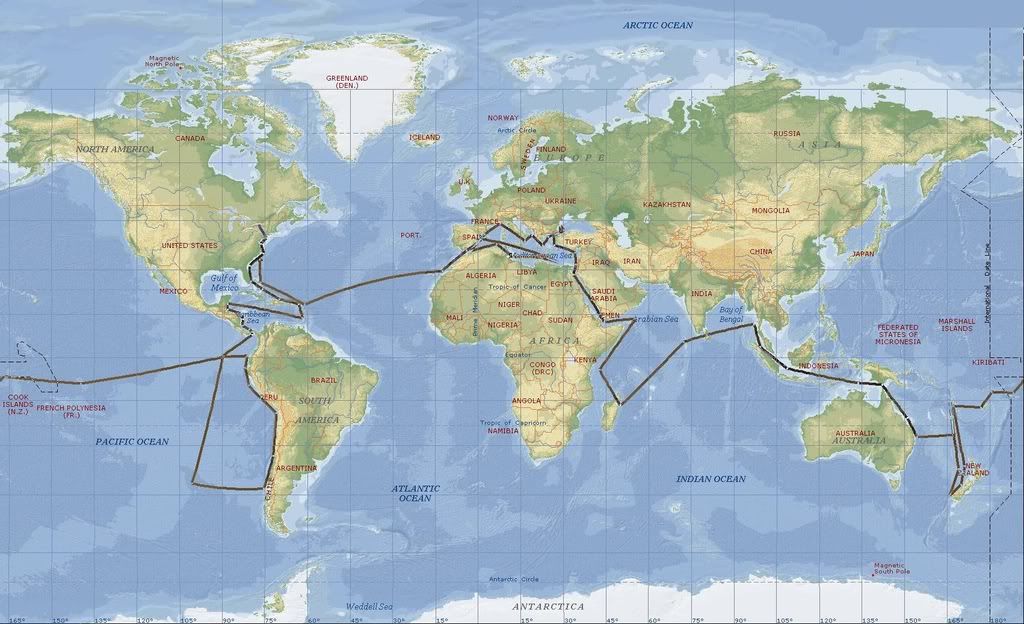
We’ve been pretty quiet on our blog since we crossed the Panama Canal at the beginning of February and the main reason is that we didn’t explore much the country. In fact, we spend most of the last three weeks preparing to cross the Pacific Ocean, which is our next step and what a step it is! There are close to 4000 nautical miles between Panama City and the Marquesas islands in French Polynesia. This is about the distance we travelled so far in our voyage! Luckily this passage will be in two steps. The first step is a passage about 1000 nm between Panama City and the Galapagos islands, where we plan to spend one to two weeks, and the second step is a 3000 nm passage from the Galapagos Islands to the Marquesas Islands. The first part should take about 6 days at sea while the second will take more than three weeks. During the passages you will be able to follow us on our blog by clicking the “Where we are” button at the top of the page. By clicking on the pin, you can read a small comment Danielle sent with our position. The blue one indicating our last position Again remember that the map on the side of the page is not going to be updated during that period since we need internet to update it and that the fishes in the middle of the Pacific are not really into the WiFi craze. You absolutely need to use the “Where we are” button since we can update it using our SSB radio or our satellite phone. Also take note that we are not going to update our position every day due to the fact that the distances involved here are so large that the pins would be one on top of each other’s anyway. Also, we don’t want to tell you at what frequency we will update our position because if for a reason or another we cannot do it we don’t want everyone following us to start panicking and thinking that something wrong happened! (especially our moms ;-) ) So, no little pin one day = don’t panic. It only means that we are probably too lazy to do an update.


Travelling such distances on a sailboat is not an easy thing and I am not talking about the endurance it takes to be bumped for weeks by the waves at sea but really of the potential breaks on the boat during the passage. Let’s put things in perspective here. During the next month and half we will use the boat nonstop under sail with all the navigation equipment turned on most of the time to travel the same distance we covered in the past 15 months. For one this boat never did a passage that long and for two neither did we! The probability that something breaks is practically 100%. The question is not whether something is going to break but how are we going to deal with it when it happens? This is exactly what we’ve been doing for the past three weeks; preparing the boat and ourselves in order to minimize all the major problems that can occur and we can try to prevent. Concretely this means to inspect thoroughly the engines and the riggings, to ensure that both autopilots are in perfect working conditions and well oiled and to ensure that all other equipments are in order. Danielle spent hours analyzing all the possible routes as well as the wind patterns of the past two months. We don’t joke with these things and we very well know that we can prepare as much as we want there will always be a high probability that something turns wrong. There are presently two boats here in Panama City who never made it to the Galapagos. The first one saw his mast snap in two and had to motor his way back while the other had a sudden wind change and got his spinnaker, a large balloon shape sail at the front of the boat used for light wind, slid under the boat, and the line got caught in his rudder and propeller and broke them both. They drifted for hours before the rescue arrived and bring them back to Panama. Thankfully in both cases nobody got physically hurt but we can assume that the cost of the repairs or associated to the rescue are probably high.
We top up the diesel tanks and our two propane tanks. We also bought so much food the boat now barely floats! Actually, we have big long green hairs growing on the two last steps because they are underwater all the time. The point of stocking so much food that we could feed all sub-Saharan Africa is not that the trip is that long, it is only a month and half, but because of the fact that in the South-Pacific Islands food is either scarce or very expensive while in Panama prices are about half of what we pay in North-America. So we did what we always do and stocked enough food for the next three or four month just to realize on the other side that it was probably not necessary. But hey, at least our little squirrel side is satisfied.

But the main reason we spent so much time in the Panama City is not as much the length of the preparation but the absence of a proper weather window to cross to the Galapagos. Thus instead of turning our thumbs in the very uncomfortable anchorage of La Playita in Panama City we spent a few days in the nearby islands where the water is much nicer and where we even caught two big fishes with the line we pull behind the boat. For us it is quite an achievement knowing that for the whole past year we never caught a fish with this line! We didn’t fish these large shrimps but instead bought them from a passing fisherman. Each of the 15 or so shrimps is about 7 inches long and we paid $8 for the lot! The fact is we are very bad fishermen. Sometimes at anchor we try to fish in the fish banks around the boat. Once the water was so clear we could see the fishes close to the hull, we threw our line directly onto them and I am sure we knock one once with our bate but it was either that they were not interested or then they would nibble at our bate until it is all gone and all this without touching the hook of course! In a few days we plan to return to the Las Perlas Islands to wait for our weather window for the crossing. We will then see if fish is on the menu again!

Friday, February 12, 2010

Crossing the Panama Canal in two steps.

We are now at a turning point in our journey. First this is the point where we cross from the Atlantic Ocean (the Caribbean Sea) to the Pacific Ocean and second we go through one of the most famous structure built by men today namely the Panama Canal. The pyramids of Egypt it is very nice but it is completely useless. For an engineer like me this is a big pile of rocks. All right, really big rocks piled over 3000 years ago I agree but useless nevertheless. The Panama Canal was built a hundred years ago almost to the day and still functions 24 hours a day 365 days a year. The six locks and the artificial lake spread over 70 km and between 20 000 and 40 000 people died building it. This is engineering! Danielle for her part appreciate of course the scale of the installations but it is also for her 25 different ways of smashing the boat into pieces if something wrong happens during the crossing!

It is then with much apprehension, excitement and curiosity that we attack the crossing of the Canal. Fundamentally, it is simply 6 locks and a lake to cross. After the 33 locks on the Erie Canal we crossed at the beginning of our journey this should be a simple matter of a well packed day. But there is a small technical difference here. You see, the Panama Canal it is not for the small and tiny boats. Over 40 super cargos cross the locks that measure 1000 feet long by 110 feet wide every day and pay between $50,000 and $200,000 to do so! Us we pay $609 and find it way too expensive. The canal authorities don’t want us here and I assume that they let us pass only because they are forced to do so in a way or another. For this reason they ensure through a set of rules and procedures that everything will go smooth once we go through because the last thing they need is a smart ass arriving with his little plastic boat and a sail and saying; “Hey, locks that’s nothing. Look at the pro here. I’ll go through this in no time.’’ And then does everything wrong and finally blocks the canal and at the same time of the most important source of revenues of the country and managed by probably the most profitable company in the world.


The rules are relatively simple and logical. We must have 4 line handlers, a captain at the wheel, 4 lines at least 120 feet long, about 10 tires on the side of the boat to fend her and finally an adviser employed by the company must be on board at all time during the crossing. In addition to this we must go to many administrative offices in Colon to process the paperwork of the Canal authorities, the port authorities, the customs and immigration. To make our life easier we hired an ‘’agent’’ named Tito how takes care of us for the paperwork, rent us the lines and tires and provides additional line handlers should we need any. Our dear Tito was not very expensive but he had two interesting characteristics. The first one is that he would never be there at the time he said he would be and the second is that no matter what, he would do what he said he would do even though most of the time it is at the last minute. Because of this everything goes smooth but we need to be very patient! But while we were waiting for Tito we prepared the boat by protecting the solar panels and by preparing the lines for the crossing.


At 16:30 on Sunday January 31, 2010 our advisor came aboard. To meet our requirement of 4 line handlers we agreed with Marion and Theo, who sail on their boat Marionetto, to cross with Chocobo first then to come back to Colon and cross with Marionetto two days later. For the fourth line handler we hired Leonardo a guy from Colon provided by Tito who wears a yellow T-shirt on the picture. In foreground you can see Marion and Theo and behind this is José our advisor for the first part of the crossing.

At the exact planned time (which changed three times within the last hour before we entered the lock) we entered the first lock called Gatun Lock, which are in fact three locks in cascade representing the first three locks of the crossing and raising us by about 85 feet from the Atlantic Ocean to Gatun Lake. The crossing of the entire canal happens over two days. The first day we go through the first three locks and spend the night on Lake Gatun then on the second day we cross Lake Gatun and go through the last three locks. On the way up we are placed behind the cargo ship crossing with us. You didn’t think that they would work their entire lock system just for a sailboat do you? But here the cargo in question is only a small 500 feet long ship so we had enough room to place our mega 40 feet sailboat behind a second boat, which is here a red fishing boat called Queen Alisa heading to Hawaii.


We are very lucky this time because there are no other boats with us to attach to the walls of the lock. The four lines are attached to large cleats on the top of the walls and each line handler ensures to keep the tension and removing the slack on his line as the boat rises. Danielle is at the wheel and moves the boat from one lock to the other once the large doors open. Everything goes fine albeit the justified fears of Danielle. I say justified because we’ve learn from our experience in the Erie Canal that rising in a lock can be fatal for the boat. When the millions of gallons of water are poured into the chamber through giant pipes under the surface large whirls are created and push the boat in all directions. This is exactly why the Canal Authorities ask for four strong lines to hold the boat in position during the rise.


A little after dark we moored Chocobo to the largest mooring buoy we’ve ever seen to spend the night in Gatun Lake. They say that the lake is infested by crocodiles but none of them bothered to come to see us. However, we could easily hear the howling monkeys from the Central American jungle surrounding the lake. Danielle pleased everybody with a delicious Suisse cheese macaroni that she made in the afternoon and then after the advisor left. After a well deserved bottle of wine we all went to bed for a short night as the departure was scheduled to be at 6:30am the next morning!

On Monday February 1st, 2010 we crossed Lake Gatun on a three hour ride and arrived at the famous Gaillard Cut, which is a giant trench dug by hundreds of thousands of workers with picks and dynamite a hundred years ago. This is here that the majority of the tens of thousands of people who died during the construction of the Canal found their last sleep. The Panamanians (or should we say the Colombians as the area was a province of Colombia at the time) who built this work didn’t dig only with their sweat but also with their blood. It is unbelievable to think that it took so long for our societies to come up with descent safety regulations at work.


For the last three locks, Pedro Miguel and the two famous Miraflores locks with their giant doors, we were rafted with another catamaran slightly larger than us. We were again lucky since no large ship was with us but only six small crafts crossing at that time. The crossing went with no incidents and by early afternoon we were safely anchored close to the marina La Playita de Amador in Panama City. We were very happy that everything went so well and were ready to go back to cross again on board of Marionetto, which should be a formality for us four since we already had the experience of crossing once. But we couldn’t be more wrong than that and what we didn’t know at the moment of leaving Chocobo for Colon is that the real adventure of this crossing was ahead of us and not behind!


We arrived by bus in Colon around 6:30pm just before sunset. Marion needed to go to the grocery before returning to the boat, which stayed at anchor in the Flats of the port of Cristobal at the entrance of the canal. We were hungry so we went to McDonalds and called Tito who was to take us to the dock where the water taxis can take us to the boat for the astronomical price of $20. Keep in mind that the 2 hour bus ride from Panama City to Colon cost $1.80 per person. But there was a problem and it was that at that time it was already dark in Colon and Tito expected us in the afternoon. The fact is that anyone who knows Colon wouldn’t dare walking at night in most of the area of the city and especially the one where the water taxis are located. Of course, this we didn’t know and for four white peoples, tourist on top of that, walking in Colon at night is like being four turkeys walking on the street on Thanksgiving! Tito was physically in Panama City at this moment and painfully explained us with his broken English that we must not set a foot on the street, jump immediately in a taxi and go spend the night at the hotel Sotelo near his office and meet him there in the morning. He couldn’t get a water taxi for us tonight because the employees and the owner of the boats would never venture on the street along the docks at night. Tito himself had lost two members of his family during the past five months as they were assassinated by the gangs of thieves marauding at night in Colon. After hanging up the cell phone we looked at each other; Oups! The McDonalds was guarded by a security guard and Danielle went to him and asked him to help us to get a cab. Finally we jumped in a taxi and once at the Sotelo hotel we were greeted by Leonardo, the guy we hired to cross the canal, who Tito had called and asked him to ensure we were safe at the hotel for the night. Finally everything ended well. The cleanness of the room was debatable but after our trip to Peru nothing bothers we anymore and at least we were not killed for the $30 we had in our pockets!


The next morning we went safely back to Marionetto and at the end of the afternoon, after Tito brought the lines, the tires and Leonardo 30 minutes before our departure time, we cross the Gatun Locks for the second time. Everything went well and just before sunset we were moored to the same buoy we used two days ago with the monkeys shouting but not showing up and a delicious dinner Marion made for us. However, it was the hottest night of our life. There was simply no wind on Lake Gatun that night and the temperature reached 32°C with 100% humidity. Even the crocodiles were too hot to come and eat us!


But the real fun really started at the Pedro Miguel lock. For the crossing Marionetto was rafted to another boat about the same size. However, we needed to attach the raft to another much bigger cruise boat doing cruises in the canal for the tourists, which was attached to the wall. Gary the captain of the other boat was the one steering the raft and the approach to the cruise boat at the very end of the lock presented itself well until we were close enough to throw our mooring lines at her. This is then that things went bad. The wind picked up suddenly and started to push the raft away from the cruise boat to a point that we couldn’t attached to her anymore. Gary turned toward the cruise boat in an attempt to bring the raft back at the cruise boat but with no success. Me, I was at the bow and I then threw my mooring line to the guy on the cruise boat so he can attach it. At this moment the wind caught the back of the raft and we turned 180° within the lock. Gary’s boat engine wasn’t strong enough for him to get back control of the two sailboats attached together and the wind was now dangerously pushing us on the closed front doors of the lock. Our only chance now was the line I threw before the boat started to turn. Everybody started shouting at the guy on the cruise boat to tell him to attach the line, which he did on a hurry. The line went straight and the raft stopped. Gary put his engine in full throttle and managed to bring back the raft. We untied the mooring line that just saved the two boats then turn the raft again and safely attached it to the cruise boat with all the passengers following our maneuver with great interests!

Eventually, with a super cargo behind us the crossing of the locks went very well even though four hours and a bottle of wine were necessary for us to recover from the Pedro Miguel lock episode! And as Marion put it so well after, this was a wonderful experience to cross the canal but if someone would ask her to cross again with them she would pass this time.


Saturday, January 30, 2010

Ready for the Panama Canal

We are scheduled to transit the Panama Canal on Sunday January 31st, 2010 at 18:45 and Monday February 1st, 2010 between 09:00 and 12:00. The transit from North to South (southbound) of the six locks is spread over two days. Late Sunday afternoon we will go through the first three locks called the Gatun Locks. We will then spend the night moored in Gatun Lake. On Monday morning we will cross the last three locks called, in order, the Pedro Miguel lock and the two Miraflores Locks to finally reach the Pacific Ocean. You can follow our transit through the Web cameras on the Panama Canal web site as shown on the picture. The address of the cameras is: http://www.pancanal.com/eng/photo/camera-java.html from where you can select either the Gatun Locks or the Miraflores locks. The tricky thing here is that we will be likely transiting with a large cargo ship and other sailboats so look carefully we are a white catamaran with yellow covers. Unfortunately, at this point we don’t know yet the exact transit time on Monday.
We arrived at the port of Cristobal, which is where the canal starts on the Caribbean side and anchored in an area called the Flats to make the necessary and painful arrangements for the transit. The interesting part of sailing to the flats is that we had to go between all the large cargos anchored inside and outside the port area. Usually when you see two or three cargos at a time it is quite nerving but here there were at least 50 spread all over and many of them were moving! Of course, the Panama Canal being the only place boats can go through to cross from the Atlantic to the Pacific oceans without sailing around South America you can imagine it is quite a busy place. At first we wanted to do the paperwork ourselves but finally decided to hire an agent called Tito who took us through all the different offices that are required to sort out the complex entry and transit procedures of Panama. And thank god we did that! For one thing all the offices are in a small town called Colon, which is the most rundown rat hole I’ve seen in my life. Sorry I don’t have pictures to show you yet but really Colon is not a place to walk with an expensive camera around the neck. Also, it is not possible to go ashore from our boat with the dingy. The Panama Canal authorities are polite and nice when dealing with us but since the control of the Canal was passed to Panama by the USA in 1999 they made everything possible to get the small boats like us out of the area. Let’s face it, when a cargo pays tens or hundreds of thousands of dollars to cross the canal a small sailboat paying $609.00 is just a nuisance. But thanks to Tito, who knows exactly where to go, what paper to bring and what to say, everything went relatively smooth and safe at least so far. We’ll see how it goes when we will be in the locks behind a behemoth spinning its propeller bigger than our entire boat!