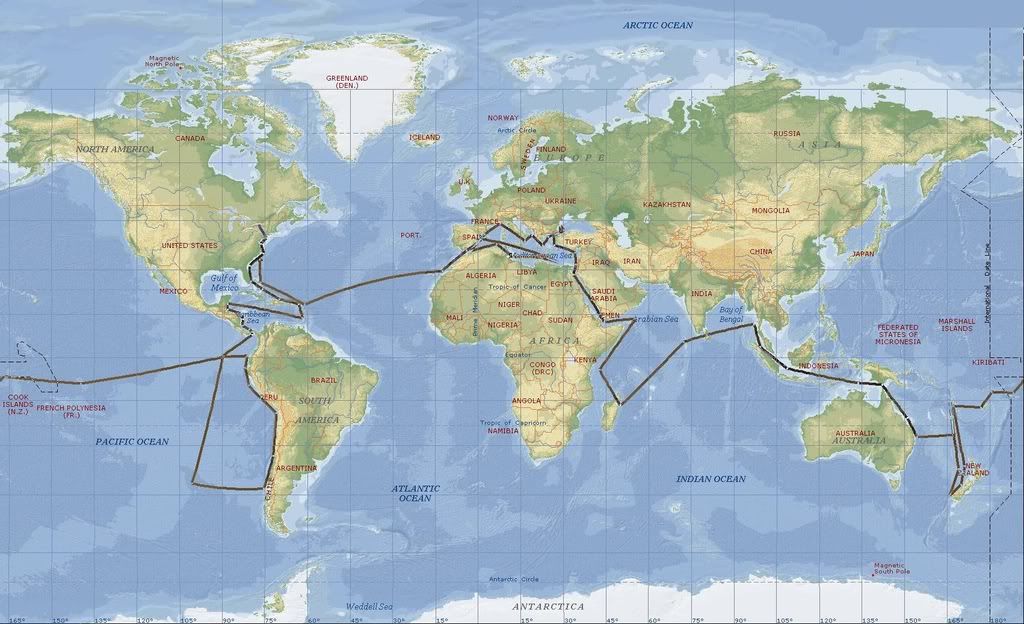
Monday, November 1, 2010

The magical island of Bali.

After Komodo our logical next stop was the legendary island of Bali. This island, located in the southern part of Indonesia, is well known; tourism being the main economic sector. Prior to our arrival we thought Bali would be just another island in Indonesia. But quickly we realized that it is a place of its own and one of its main attractions is Balinese dancing. During a dinner show we attended one of the many dance shows presented across the island but unfortunately no picture would ever make justice to the sophistication of the moves in this dance. One after the other the four dancers demonstrated their skills in the mastering of the complex movements of the fingers, the eyes, the head and every other muscle they possess and seem to be able to move independently. Of course, I didn't miss the opportunity, at the end of the show, to get a picture in the company of the four pretty Indonesian dancers!


In addition to tourism Bali is also in the rice growing business but doesn't miss the opportunity to take advantage of the fusion of the two. For instance this terrace; although used to grow real rice it is so pretty that all the best view points are crowded with tourist stands and the whole nine yards. On the second picture we stopped along a regular rice field where we could have a closer look at the "sticky" rice, which is very tall, and the normal rice at about half the height. Obviously, for Asians seeing a rice plant is as common as seeing a corn cob back home. But for us, rice like bananas grow on the shelves of the supermarket! Putu, our guide, found it a bit amusing that we asked him to stop to look at the plant, probably the most grown in the world.


We can't separate Bali and religion. While the rest of Indonesia is mainly Muslim, with 240 million inhabitants this makes it the one of the largest Muslim country in the world, people of Bali are of the Hindu faith and we can apparently find over 1000 temples on the island to worship Brama (the creator), Wisnu (the protector) and Siwa (the destructor/reconstructor) although the other spirits are not left apart. Everywhere we can see the daily offerings, called canangs, people leave on their doorsteps in the morning to attract the favors of the good Gods or to keep away the evil spirits while trying to keep a balance between the two groups. The offerings in questions are almost always small square baskets about 15 cm (6 inches) on the side in which they put flowers and/or fruits and offer to divinities. Of course, if you are too busy to make your own canang it is possible to buy them already made at the local market! Apparently Gods are not very bothered on the effort. The only thing though is they put the offerings in the middle of the door hence we have to be very careful where we put our feet not to walk on the offering and, we can always suppose, attract on our host the wrath of the Gods! It is also interesting to notice that in the polytheist religions (with several gods) like this one or the ones of the Incas we saw in Peru, have a relationship with their divinities based on exchange and reciprocity while the monotheist religions (with a unique god) such as the Judeo-Christian religions have a relationship based on submission before a punishing god.


One of the most visited places in Bali is the Tanah Lot temple built on a large rock located in the sea close to the shore and accessible only at low tide. The temple itself is, of course, pretty but what is even more interesting is what tourism has done with it. Tourists gather here by hundreds every day and they inevitably attracted with them a myriad of vendors like this little girl who was selling a kind of doll on a stick. The girl in question seemed to be at the beginning of her vendor's career and, although we didn't ask, was probably of legal age to work in Indonesia! But the street vendors, or this one who offered to show us a "holy" snake in exchange of a few rupiahs, were nothing compare to the tourist boutiques at the site entrance. Normally, near a tourist interest point we would find a strip of boutiques selling the usual crap such as all kind of sculptures, masks, sarongs, t-shirts, postal cards and so on. But here it is an entire village of boutiques that we find with streets and all! In fact, the boutique site is larger than the temple one! We nevertheless felt for a vendor who offered us to take a picture of us with his large python. I volunteered to wear the little crawling beast at the neck while Danielle said "No Way!" and was happy to just take pictures of me.


Ubud village has a macaque sanctuary and we did a quick stop to visit our distant cousins. Ok well, at looking at some people on the street or in politic we may come to think that the inhabitant of the Ubud reserve are not cousins that distant but our goal here was to see monkeys and not to conduct an anthropological research on the origins of political men!


Art and workmanship are intrinsically part of Bali. Our guide took us to see wooden sculptures, jewelry making and basket or motorcycle . weaving. Wooden sculptures are characteristic of Asia, i.e. extremely beautiful and with an incredible level of details. Jewels were on the same line and while we couldn't afford to buy these beautiful nautiluses set with silver we still acquired two necklaces and two silver wire sculpture frames. However, the interesting part here is yet again the people. At the jewelry store prices were bits high but not excessive. But the saleswoman was giving us 20% off right away and clearly let us knows she was open to dealing. After a few minutes of back and forth with the price we would eventually converge on a price about 50% of the tag price making the purchasing quite attractive. Of course the negotiation was a bit difficult but was made in good faith and always with a smile. As for the wicker motorcycle we didn't buy it but Danielle always wanted one of these triangular hay hats Asians wear in the rice fields and we found a nice authentic one in a village market.


(photo7) We found these signs in every Hindu temple. It seems that menstruations have something impure for Hindus. (If the picture is not yet posted the sign says "Your attention please. During menstruation ladies are strickly not allowed to enter the temple. Thank you")

Friday, October 22, 2010

Komodo Island, Indonesia

A definitive must see in Indonesia is the Komodo National Park, which is the one place in the world where legendary Komodo dragons can be found. The 2 meter lizards lay here and there on the five islands forming the park and, accompanied with a guide, we were able to have a look at these large predators whom, although not as dreaded as the crocodiles in Australia, call for a certain respect. We were lucky enough to see four of them during our visit as well as deer, birds and red ants.

Seeing the dragons was surely a treat but other than being big fat lizards lying very passively on the ground they were not much of an interest. However, the local people of Komodo were by much more interesting to see and to deal with. Upon arrival at the Komodo village we were immediately surrounded by local fishermen who, when the small fishes found in the area gets less abundant, go after the larger fishes sailing around the world on a catamaran to sell them some Komodo souvenirs! We usually don't buy tourist stuff like that but when we saw Komodo it was hard not to encourage them a little bit. Other than lizards and giant fruit bats there is basically nothing on this island for the locals to make a living of any kind. We used a free mooring ball for the night and they were all over us to help us with anything we needed and spending a few dollars was just the least we could do really. So after less than half an hour we were the new proud owners of three sculpted wooden statues of Komodo dragons and three tiny fishes that were already half dried after staying too long in the guy's boat under the scorching Indonesian sun but the poor guy had followed us for over half an hour to take us to the mooring ball so I had to buy something from him. I gave him $1 for his three decomposing beasts. There was no way we would even venture thinking about eating them and I just left them on the deck and finally forgot them when we left for our visit at the Komodo Park.

One of the fishermen took us to the park located about 2 km from where we were mooring. The ride in the boat was a treat. This is actually the one with the blue tarpaulin on the picture. You can also see a new cost effective design of a dinghy they use here to commute from one boat to another! Why bother with inflatable boats and outboard motors when a good reliable block of Styrofoam just does the job? The mono-cylinder engine, on the fishing boat, had to be started by hand with a sort of handle while to fuel came from an old plastic jug formally used for water and sitting just on the deck with its hose plunged through the opening. Of course don't even think about glow plugs or anything fancy such as a muffler or a decent exhaust pipe for instance. The exhaust was coming straight out of the engine into the section under the tarpaulin. Thank God, while the boat was moving, the breeze was pushing the black smoke toward the stern just where the driver sat! I don't think I need to mention the kind of noise that was coming out of this machine probably devised before man invented fire. But that's exactly why this was such a treat. For $10.00 they took us to the park, waited during our entire visit and took us back to the boat; all this while being nice, polite and very attentive. For that price in Canada we couldn't pay someone to give us a kick in the ass! As we climbed back on Chocobo we noticed that local birds didn't find the three fishes, I left on the deck, that disgusting and had feasted while we were away leaving of course half of the inner organs scattered all over!

With the help of the locals we were able to do all our visits the first day we arrived allowing us to leave the next day to an anchorage north of Komodo. The place was simply beautiful with clear water; we could see the bottom while the depth sounder indicated 80 feet (25m), and colorful coral everywhere. The only thing though with Indonesia so far is the fact there is no wind enough to make any decent sailing and we are forced to motor all the time. But on the plus side, no wind also means no waves and the rides are extremely smooth so we don't really complain especially since diesel here is relatively cheap.

Sunday, October 10, 2010

Beginning Indonesia with Kupang.

Since we had to motor all the way from Darwin to Kupang our main diesel tank started to be seriously low and the first thing we had to do after the entry procedures was to fill up. This was especially true since the weather forecasts for Indonesia show this is a windless country. On the left you can see Napa our agent who took care of the entry procedures and provided the fuel. Of course, no fuel dock here with a nice pump at hand so 10 Jerry cans were necessary to carry the 240 liters we required and since we don't know the state of the fuel we had to filter everything to remove the dirt and water that could be contaminating it but to our astonishment it was fairly clean.
A quick note about entry procedures in Indonesia; basically they are very complex and Danielle has been working on this for three months. The language barrier and the administrative cumbersomeness forced us to use an agent who took care of all the local procedures. We still had to search for info, find an agent, contact him and get the visas. For the visas we got them at the Indonesian Embassy in Darwin. In all, the fees for the visas, the cruising permit, the bond waivers, the agents services and the lost in currency changes sum up to about $860.00, which makes Indonesia the most expensive country in our trip to get in.


There is nothing better to commute than buses. Indonesia not being a car country there is a bus every other minute to take us for a $0.20 fee. Quite a contrast with Australia where the fees were $2.00 and we had to wait sometimes up to 1½ hour for to bus to show up! As expected people here are very nice and patients with us. However, there is something different with the other countries we went. Normally people are used to see white tourists walking the streets and for them we are like the trees; of no interests unless they want money from us. But here people looked at us with a certain curiosity. Some, usually older, would smile at us and say hello but most of them seemed not to know how to behave went crossing us on the street. In those cases all we had to do is to give them a nice smile and say ''Hello!'' to startle them and so they realized we are simply normal human beings. Every time their face would burst into a huge genuine smile indicating their relief. In one case though a group of men behind their street counters gave us the strong feeling they were making fun of us but since we didn't understand anything they said it was hard to get upset. An interesting fact is that even if most of them gave us the impression we came from Mars they all seemed to know how to say "Hello mister!" even the youngest one who had barely learned to talk. We will probably solve that mystery during the month and a half we plan to stay in Indonesia.


As a routine for us now our walks in town usually are aimed at replenishing fruits and vegetables. Kupang being a city of 300,000 it's not the hardest thing in the world to find someone to sell us some. Prices are relatively low but we got tourist priced at some point and, the language barrier not helping, we seriously have to refine our dealing skills.
By the way, for those who are a bit more awake, you may have notice that we are now in Timor, which is a large island in Eastern Indonesia. Timor made the front page of the newspapers at the end of the last century due to the quasi genocide unrolling here. This was in fact East Timor the other part of the island while we are in West Timor who seems to live in peace as part of Indonesia. As for East Timor, if I understood the story correctly, it seemed to have had lived some very sad days when a regime came in place and fought the Indonesian regime with the consequence that 200,000 out of the 750,000 inhabitants of the area got slaughtered by the conflict but mostly by the local regime. East Timor is one of the two places in the world, after the Gulf of Aden, where insurance companies don't even want to talk about boat coverage!


Tuesday, October 5, 2010

Arrived in the Republic of Indonesia.

We arrived in at the city of Kupang, West Timor in the Republic of Indonesia, from Darwin in Australia, on September 27th, 2010 after a passage of 476 nautical miles (885 km) that took us 4 days, 3 hours and 30 minutes for an overall average speed of 4.8 knots. Just a few miles from Kupang we crossed the furthest point from home in this trip and were at 15,880 km as the crow flies. Therefore, we are technically, from now on, going back home. The ride across the Timor Sea was very smooth with virtually no wind for the entire trip forcing us to motor all the way. Motoring might be noisy but it also means infinite electricity and water supply, which we can live with. Down here it is hot and humid so Danielle would take up to three showers per day :-) Ah! We love the desalinator!

Monday, September 20, 2010

Crocodiles, termites and national parks.


Before leaving Australia in destination of Indonesia we had to go visit Australia at least a bit. But before I tell you of our visits it would be good to put you in context. Australia is big, very big; in fact it is simply humongous. Darwin is the capital city of this province called the Northern Territories and, as its name states it, it’s in the North and cover about one sixth of the Australian territory. It is large but there’s almost no population about 250,000 people including the aboriginals who were already here when the Europeans arrived. Their story is very similar to the one of our Native American i.e. they lived on their lands with Stone Age means, the Europeans arrive, and the Europeans want the land and mostly what’s under it but not the people above. They kill the poor folks who try to defend themselves with arrows and spears against muskets, sharp swords and a range of viruses they never heard of and I am sure they couldn’t even pronounce the names without painfully twisting their tongues. After a few centuries of colonization half the first nations are decimated and the survivors claim the right to a certain level of self-determination with the goal of saving their ancestral culture. Of course, we could debate at length the validity of wanting to keep a way of life dating from the Stone Age. It’s as if I was claiming my right to cut my flint to make my spears. Well these people can do what they want, right? All right I know that I am sarcastic and keeping his culture is a much more complex and important thing than that so you don’t have to tell me.


The good news for them is they got the right to manage the territory and their businesses and things seem to go well. An interesting aspect of this story is that one of their obligations in order to keep the management of the territory is for them to burn the land every other year! The rationale is simple; during the dry season the bushes and grass growing between and under the trees become so dry that a lightning falling on them would cause devastating forest fires. So they burn the bushes on half the land every year in order to prevent the propagation of forest fires. But we are talking about a huge territory here! Of course nobody here talks about greenhouse gas production while back home we are tagged environmental assassins because we leave our car running for five minutes to warm it up before leaving to work in the winter by -25°C! But this is another story and the important point to know about the area is that half of the territory within 500km from Darwin is made of wetlands hence contains an incredible biological diversity. The water streams surrounded by swamps, called here billabongs, are protected by the creation of large national parks among which are the Kakadu Park classified world heritage by the UNESCO and the Litchfield Park both of which are really beautiful. With untied again the strings of our purse and went to visit them.


We started with Kakadu Park and the first site we visited was aboriginal paintings on the mountain walls. Looking at the aboriginal work we could think we are in front of ancient frescos dating from the time men fought for the control of fire but it is not the case. The painting you see on this picture was made sometime in the ‘60s by a man called Barramundi Charlie the last descendant of his nation, that I cannot remember the name, and his soul went back to the earth around 1976 taking with him all that remained of his culture and the memories of his people. But many years before dying Barramundi Charlie showed the painting of his people to a crew of the BBC, filming a documentary in the region, and told them that each of them represented a story but he refused to tell them what the stories were but for this one on the picture, which is an educational picture targeting the youth of his nation. In a nutshell the story goes like this. For the aboriginal people incest is strictly prohibited for the obvious reason to save people to suffer the same faith than some Kings of England at a certain time in history! The guy at the top of the painting is Namarrgon who felt in love with his sister Barrginj who appears in white below his right leg. The tribe members obviously found out about it and the elders, using their magic, punish them by changing the brother into a crocodile and the sister into a serpent, two solitary animals, so they were forbidden any personal relations in the future. As for the women with their breast uncovered at the bottom of the painting we are not sure how they related to the story. The story is really instructive and all but looking at the painting some questions come to mind. First, if the painting targeted the youth of his people and Barramundi Charlie was the last survivor of his them then why did he paint it in the first place? Secondly, I understand that the object of the painting is the sexual relationship within the same family but are the widely spread legs and oversized genitals really necessary? In fact when we add the breast naked women and the fact that Barramundi Charlie didn’t have a wife for quite some times we are inclined to think that this drawing is simply a kind of aboriginal Playboy! Of course by respect to the man and especially to his gone nation we will take his word for it and believe him.


After M. Charlie’s frescos we went on a tour boat on the Yellow Water Billabong to watch the unique wildlife of these wetlands. Of course the highlight of the visit was the dreaded crocodiles! There are two kinds of crocs in Australia; the fresh water crocs, which are smaller and not very dangerous, and the salt water crocs called the salties which are much bigger and with whom having a swim to pet their nose is really not a good idea! We had the chance to close sight three or four of them during our ride and we were very happy the boat we were in was all made of solid aluminum. The little beasties are very cute on pictures but having one only a few meters away makes you show a bit more respect.


Yellow Water Billabong was much more than just crocodiles. It was an abundant fauna, mostly birds, and a unique flora. Our captain was an experimented guide and she knew exactly how to steer the pontoon to take us less than 5 meters (15 feet) of the birds without scaring them away so we could watch them closely and take good pictures. Ducks, geese, egrets and other great waders were at the rendezvous to our great pleasure.


Two days later we took another tour that first took us on a boat along the Adelaide River to see the jumping crocodiles. Let’s mention this is not a special kind of crocodile but rather our guides who make them jump by showing them a juicy piece of meat attached to a kind of fishing rod. The one you see on the picture was a real monster the kind coming directly from a movie such as “The African Queen” or “King Kong”. It’s the dominant male of this section of the river, which is 150 km (95 miles) long with a crocodile population of 6000 to 7000. According to our guide this one would be about 60 years old, measures close to 6 meters (18 feet) and would weight about 1000 kg (2200 lbs)! It was even bigger than Goliath we saw in Cairns in his cage but here we were in the wild not in a zoo!


For more than an hour, our guides made the crocs jump by offering them large pieces of pork, which I consider a blatant discrimination against the Muslim crocs! Danielle even let herself jump in front of the site entrance but I didn’t venture to throw her a steak. If you think the large teethed lizards are mean you never upset Danielle before! By the way crocs are no big eaters and feed only a few times a week. Crocodiles in captivity not doing a lot of exercise are fine with one meal per week. They mainly derive their energy from the sun through their skin and are basically large teethed solar panels.


Our visit continued in Litchfield Park and as we say; a guided tour, wherever you are in the world, is not a good tour if you don’t see a waterfall! Here we saw three and at the last one we slipped in our swimming suits and dove in the fresh water. It was very refreshing but to come back to the bus we had to climb up a 135 steps stair! No need to say we were as sweaty up there as we were when we arrived.


In North Australia it is not only the 6 meters crocs that are impressive the termites are also quite something and they appear to be pretty good architects. We find many types of termites in Litchfield Park but our visit focused on two specifically. The first one build cathedral mounds which are tall tour shaped structures where they shelter when the area floods during the wet season. The second type of mounds is called magnetic since all mounds are facing the magnetic north. Nope, this is not tomb stones you see on the picture but termites mounds. It is interesting to note that termites are found everywhere in the area which makes a total population of many billions. Danielle reminded me that quarantine people, when a boat comes into Australia, search thoroughly every pieces of wood on the boat in order to find out whether we carry with us …. any termites! In the world of xenophobia it is hard to beat!


Obviously we couldn’t go through Australia and not taste their famous Fish & Chips which the taste only equal its fat level! We went to a small restaurant located in the Fishermen’s Warf area where locally caught fish is sold. The fried barramundi was really good and I am talking about the fish here not the aboriginal I talked about previously! Fries were not bad either and it is interesting to notice that Australians don’t call them “French fries” but instead use the name “chips” hence the name of Fish & Chips. Similarly, shrimps are called “prawns” and don’t get it wrong because a few times we ordered shrimps and the person serving us seemed to have no idea what we were talking about. A quick note here. We already mentioned how expensive things are in Australia, well the fish, the fries, two beverages each and four breaded shrimps cost us close to $50! And at this price we eat on a piece of paper with plastic forks.
Now that we had a good visit of Australia we will leave within a week to Indonesia, which is North-West of Australia. According to our cruising guides internet is not really strong in Indonesia so it is possible that we won’t be able to post anything for a while. But as soon as we get a decent connection we’ll show you the marvel of this great South-East Asian country.

Saturday, September 18, 2010

Sailing the Coral Coast.

Our next step was now to sail from Cairns, on the East coast of Australia, to Darwin on the North side. This meant sailing the northern part of the Australian East coast up to Cape York and the Torres Strait by sailing inside the famous Great Barrier Reef, which was made even more famous in the movie “Finding Nemo”. So while wrapping up in Cairns we were very excited and looking forward to go sailing in these paradise waters we heard so much about and anchoring on the lee of a sand island in waters so clear you have the impression the boat is floating in mid air and finally at the pinnacle of our fantasy we would snorkel among colorful corals where we would find Nemo hidden in his anemone. But we hadn’t come out of the six mile long channel leading out of Cairns that we had a very clear reality check; the wind was blowing! During the week or so we took to reach Cape York we had to sustain winds with an average speed of 25 knots going 35 knots at night. The night anchorages were by all standards the crappiest ones we’ve ever seen and consisting, in the best cases, of a sand pit sticking out of the water offering no wind shelter and barely any wave protection. We sure were sailing fast with such wind strength and that’s what we needed since the whole area is formed of scattered reefs we were forced into specific channels, which were very busy with the continuous stream of cargo ships sailing along the Australian coast. The reefs here are not coral reefs but rock reefs and while anchored in the middle of a rolly anchorage and sustaining near gale force winds the last thing that came to our mind was to put our fins and try to find Nemo in those crocodile infested waters and anyway even if he was there he would be probably suffocating in those sandy waters offering less than 10 feet of visibility. So, to say the least we were very disappointed by this part of Australia but on the plus side I should mention that reefs offer an excellent protection against the ocean swell and combined with the constant wind and currents we were making very fast progresses all the way.

I might sound a bit negative here in my description of the area but one thing we cannot take away from this part of the Australian coast is the magnificent beauty of the landscape. The high humidity level gives beautiful sunsets and the rocky shores present red, yellow and white cliffs standing straight like guardians of the sea. We took the time to take a walk on Flinders Island where I was hoping to sight some crocodiles but to Danielle’s relief we saw none :-(

After the Coral Sea we then reached the Torres Strait, which is the channel between Australia and Papua New Guinea, allowing us to transit from the Pacific Ocean into the Indian Ocean. The trick about Torres Strait is that there are islands and reefs everywhere and the water between them is very shallow. The most straight forward way to transit is to pass through the “Prince of Wales” channel keeping on port Wednesday, Thursday and Friday islands. Now here’s a little quiz for you erudite folks; on what days of the week were those islands discovered by the first explorers? The crossing of the strait went very smooth as we timed our passage with the tidal stream, which can reach up to three knots, and all we encountered along the way was actually not a cargo ship but a submarine! With 35 feet of water in the channel they obviously had to surface for the crossing.

With the Torres Strait behind us we then entered the Gulf of Carpentaria in the Arafura Sea on the North side of Australia. This is a huge shallow gulf which required about two days to cross. At this point we had given up on the idea of stopping anywhere in these deserted aboriginal lands and were sailing directly to Darwin. After the Gulf of Carpentaria we sailed, for one day, the coast of the Northern Territories then entered another gulf called the Van Diemen Gulf with tidal streams flowing up to 4 knots at its entrance and exit. This part was straight forward beside the weird gusty winds we had in the first half of the night and the daily calls from the customs plane checking our identity and whereabouts as the Australian Authorities exercise a tight control of this border used a bit too often by illegal immigrants trying to find a better life in Australia from the poor South-East Asian countries. All along the way we had to plot a detailed route to follow and plan the daily anchorages. Here you can see Danielle working on the navigation software to analyze the charts and ensuring we make the most of each day as our time window in Australia is quite limited due to the cyclone season starting in October in the area.

By lack of seeing any Kangaroos so far we took the opportunity to eat some at least! Where in the world could you find Kangaroo steaks on the shelf at the grocery store??? The meat of the marsupial was actually pretty good and we fixed it roasted in the oven with carrots and potatoes. It was yummy and tender and no, it doesn’t jump in the stomach afterward!

Saturday, September 11, 2010

A little bit of Cairns, Australia.

After countless working days dedicated to the boat we took the time to see a bit of Australia. We went to the Cairns Wildlife Dome, which is a small biodome built over a casino where we can find a colorful sample of the Australian’s fauna and flora. Being used to the human presence animals were easy to approach for the pictures. To try to take a picture of a parrot in the wild is practically impossible even if we find them in large number. We can hear them but they are hard to see and when we finally see one it takes a zoom the length of a trumpet to get a decent frame.


But the key animals here were koalas and “Goliath” the crocodile. Koalas seem to sleep all day so pictures were easy to take. As for Goliath, this 4m (12 feet) long crocodile, he sleeps all day long as well but the picture were taken with a fence in between thank you very much! The worst is that the Australian Coast we now need to sail to get to the Torres Strait is infested of those big large teethed lizards. I am so looking forward to swim in the Great Barrier Reef with a knife between the teeth in case we meet the rest of Goliath’s family!

Like any good developed country Australia has its fast-food chains. At first we may think we have here one of the local chain with a familiar look. But look closer to the “Hungry Jack’s” logo on the left of the counter. It really starts looking like “Burger King” isn’t it? Well that’s exactly what it is with the Woppers and all. The reason is simply because the name “Burger King” was already used before the American chain came here to fatten Australians. It is quite amusing to see many well known brands in North America named differently. For instance Kellogg’s “Rice Crispies” become here “Rice Bubbles” and obviously we bought some with two bags of marshmallows. You have no idea how we look forward to make Rice Bubbles squares!

Here Danielle saunters along the dock at Marlin Marina in Cairns. There’s nothing particular about this picture other than Danielle’s nice smile although surmounted by her large sunglasses she bought in Panama (in Latin America they like huge sunglasses!). Latin America is maybe far behind but the sunglasses are very good so too bad for the local fashion.