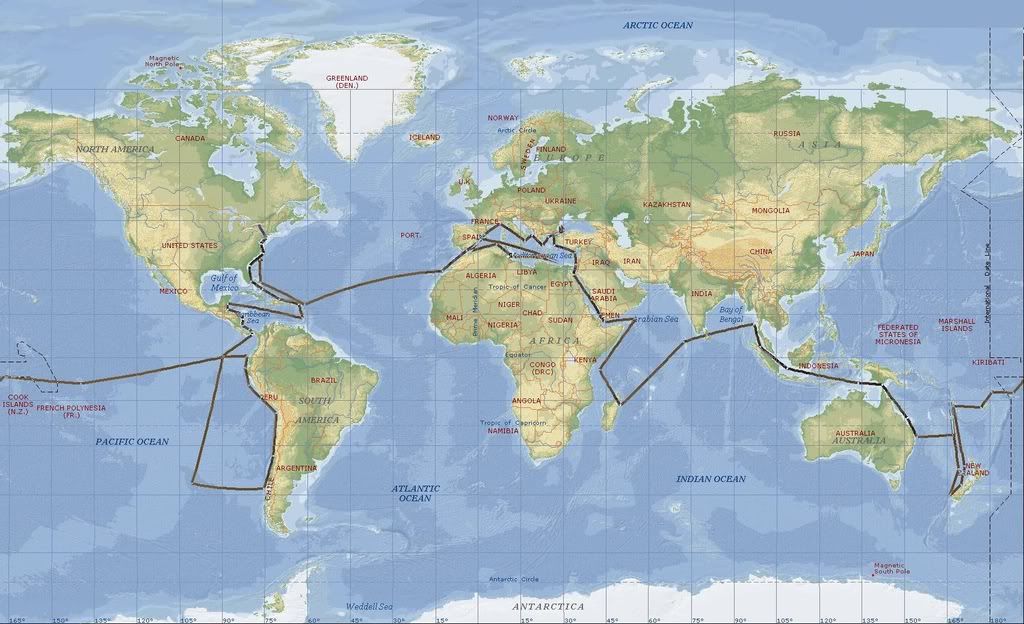
Monday, September 20, 2010

Crocodiles, termites and national parks.


Before leaving Australia in destination of Indonesia we had to go visit Australia at least a bit. But before I tell you of our visits it would be good to put you in context. Australia is big, very big; in fact it is simply humongous. Darwin is the capital city of this province called the Northern Territories and, as its name states it, it’s in the North and cover about one sixth of the Australian territory. It is large but there’s almost no population about 250,000 people including the aboriginals who were already here when the Europeans arrived. Their story is very similar to the one of our Native American i.e. they lived on their lands with Stone Age means, the Europeans arrive, and the Europeans want the land and mostly what’s under it but not the people above. They kill the poor folks who try to defend themselves with arrows and spears against muskets, sharp swords and a range of viruses they never heard of and I am sure they couldn’t even pronounce the names without painfully twisting their tongues. After a few centuries of colonization half the first nations are decimated and the survivors claim the right to a certain level of self-determination with the goal of saving their ancestral culture. Of course, we could debate at length the validity of wanting to keep a way of life dating from the Stone Age. It’s as if I was claiming my right to cut my flint to make my spears. Well these people can do what they want, right? All right I know that I am sarcastic and keeping his culture is a much more complex and important thing than that so you don’t have to tell me.


The good news for them is they got the right to manage the territory and their businesses and things seem to go well. An interesting aspect of this story is that one of their obligations in order to keep the management of the territory is for them to burn the land every other year! The rationale is simple; during the dry season the bushes and grass growing between and under the trees become so dry that a lightning falling on them would cause devastating forest fires. So they burn the bushes on half the land every year in order to prevent the propagation of forest fires. But we are talking about a huge territory here! Of course nobody here talks about greenhouse gas production while back home we are tagged environmental assassins because we leave our car running for five minutes to warm it up before leaving to work in the winter by -25°C! But this is another story and the important point to know about the area is that half of the territory within 500km from Darwin is made of wetlands hence contains an incredible biological diversity. The water streams surrounded by swamps, called here billabongs, are protected by the creation of large national parks among which are the Kakadu Park classified world heritage by the UNESCO and the Litchfield Park both of which are really beautiful. With untied again the strings of our purse and went to visit them.


We started with Kakadu Park and the first site we visited was aboriginal paintings on the mountain walls. Looking at the aboriginal work we could think we are in front of ancient frescos dating from the time men fought for the control of fire but it is not the case. The painting you see on this picture was made sometime in the ‘60s by a man called Barramundi Charlie the last descendant of his nation, that I cannot remember the name, and his soul went back to the earth around 1976 taking with him all that remained of his culture and the memories of his people. But many years before dying Barramundi Charlie showed the painting of his people to a crew of the BBC, filming a documentary in the region, and told them that each of them represented a story but he refused to tell them what the stories were but for this one on the picture, which is an educational picture targeting the youth of his nation. In a nutshell the story goes like this. For the aboriginal people incest is strictly prohibited for the obvious reason to save people to suffer the same faith than some Kings of England at a certain time in history! The guy at the top of the painting is Namarrgon who felt in love with his sister Barrginj who appears in white below his right leg. The tribe members obviously found out about it and the elders, using their magic, punish them by changing the brother into a crocodile and the sister into a serpent, two solitary animals, so they were forbidden any personal relations in the future. As for the women with their breast uncovered at the bottom of the painting we are not sure how they related to the story. The story is really instructive and all but looking at the painting some questions come to mind. First, if the painting targeted the youth of his people and Barramundi Charlie was the last survivor of his them then why did he paint it in the first place? Secondly, I understand that the object of the painting is the sexual relationship within the same family but are the widely spread legs and oversized genitals really necessary? In fact when we add the breast naked women and the fact that Barramundi Charlie didn’t have a wife for quite some times we are inclined to think that this drawing is simply a kind of aboriginal Playboy! Of course by respect to the man and especially to his gone nation we will take his word for it and believe him.


After M. Charlie’s frescos we went on a tour boat on the Yellow Water Billabong to watch the unique wildlife of these wetlands. Of course the highlight of the visit was the dreaded crocodiles! There are two kinds of crocs in Australia; the fresh water crocs, which are smaller and not very dangerous, and the salt water crocs called the salties which are much bigger and with whom having a swim to pet their nose is really not a good idea! We had the chance to close sight three or four of them during our ride and we were very happy the boat we were in was all made of solid aluminum. The little beasties are very cute on pictures but having one only a few meters away makes you show a bit more respect.


Yellow Water Billabong was much more than just crocodiles. It was an abundant fauna, mostly birds, and a unique flora. Our captain was an experimented guide and she knew exactly how to steer the pontoon to take us less than 5 meters (15 feet) of the birds without scaring them away so we could watch them closely and take good pictures. Ducks, geese, egrets and other great waders were at the rendezvous to our great pleasure.


Two days later we took another tour that first took us on a boat along the Adelaide River to see the jumping crocodiles. Let’s mention this is not a special kind of crocodile but rather our guides who make them jump by showing them a juicy piece of meat attached to a kind of fishing rod. The one you see on the picture was a real monster the kind coming directly from a movie such as “The African Queen” or “King Kong”. It’s the dominant male of this section of the river, which is 150 km (95 miles) long with a crocodile population of 6000 to 7000. According to our guide this one would be about 60 years old, measures close to 6 meters (18 feet) and would weight about 1000 kg (2200 lbs)! It was even bigger than Goliath we saw in Cairns in his cage but here we were in the wild not in a zoo!


For more than an hour, our guides made the crocs jump by offering them large pieces of pork, which I consider a blatant discrimination against the Muslim crocs! Danielle even let herself jump in front of the site entrance but I didn’t venture to throw her a steak. If you think the large teethed lizards are mean you never upset Danielle before! By the way crocs are no big eaters and feed only a few times a week. Crocodiles in captivity not doing a lot of exercise are fine with one meal per week. They mainly derive their energy from the sun through their skin and are basically large teethed solar panels.


Our visit continued in Litchfield Park and as we say; a guided tour, wherever you are in the world, is not a good tour if you don’t see a waterfall! Here we saw three and at the last one we slipped in our swimming suits and dove in the fresh water. It was very refreshing but to come back to the bus we had to climb up a 135 steps stair! No need to say we were as sweaty up there as we were when we arrived.


In North Australia it is not only the 6 meters crocs that are impressive the termites are also quite something and they appear to be pretty good architects. We find many types of termites in Litchfield Park but our visit focused on two specifically. The first one build cathedral mounds which are tall tour shaped structures where they shelter when the area floods during the wet season. The second type of mounds is called magnetic since all mounds are facing the magnetic north. Nope, this is not tomb stones you see on the picture but termites mounds. It is interesting to note that termites are found everywhere in the area which makes a total population of many billions. Danielle reminded me that quarantine people, when a boat comes into Australia, search thoroughly every pieces of wood on the boat in order to find out whether we carry with us …. any termites! In the world of xenophobia it is hard to beat!


Obviously we couldn’t go through Australia and not taste their famous Fish & Chips which the taste only equal its fat level! We went to a small restaurant located in the Fishermen’s Warf area where locally caught fish is sold. The fried barramundi was really good and I am talking about the fish here not the aboriginal I talked about previously! Fries were not bad either and it is interesting to notice that Australians don’t call them “French fries” but instead use the name “chips” hence the name of Fish & Chips. Similarly, shrimps are called “prawns” and don’t get it wrong because a few times we ordered shrimps and the person serving us seemed to have no idea what we were talking about. A quick note here. We already mentioned how expensive things are in Australia, well the fish, the fries, two beverages each and four breaded shrimps cost us close to $50! And at this price we eat on a piece of paper with plastic forks.
Now that we had a good visit of Australia we will leave within a week to Indonesia, which is North-West of Australia. According to our cruising guides internet is not really strong in Indonesia so it is possible that we won’t be able to post anything for a while. But as soon as we get a decent connection we’ll show you the marvel of this great South-East Asian country.

Saturday, September 18, 2010

Sailing the Coral Coast.

Our next step was now to sail from Cairns, on the East coast of Australia, to Darwin on the North side. This meant sailing the northern part of the Australian East coast up to Cape York and the Torres Strait by sailing inside the famous Great Barrier Reef, which was made even more famous in the movie “Finding Nemo”. So while wrapping up in Cairns we were very excited and looking forward to go sailing in these paradise waters we heard so much about and anchoring on the lee of a sand island in waters so clear you have the impression the boat is floating in mid air and finally at the pinnacle of our fantasy we would snorkel among colorful corals where we would find Nemo hidden in his anemone. But we hadn’t come out of the six mile long channel leading out of Cairns that we had a very clear reality check; the wind was blowing! During the week or so we took to reach Cape York we had to sustain winds with an average speed of 25 knots going 35 knots at night. The night anchorages were by all standards the crappiest ones we’ve ever seen and consisting, in the best cases, of a sand pit sticking out of the water offering no wind shelter and barely any wave protection. We sure were sailing fast with such wind strength and that’s what we needed since the whole area is formed of scattered reefs we were forced into specific channels, which were very busy with the continuous stream of cargo ships sailing along the Australian coast. The reefs here are not coral reefs but rock reefs and while anchored in the middle of a rolly anchorage and sustaining near gale force winds the last thing that came to our mind was to put our fins and try to find Nemo in those crocodile infested waters and anyway even if he was there he would be probably suffocating in those sandy waters offering less than 10 feet of visibility. So, to say the least we were very disappointed by this part of Australia but on the plus side I should mention that reefs offer an excellent protection against the ocean swell and combined with the constant wind and currents we were making very fast progresses all the way.

I might sound a bit negative here in my description of the area but one thing we cannot take away from this part of the Australian coast is the magnificent beauty of the landscape. The high humidity level gives beautiful sunsets and the rocky shores present red, yellow and white cliffs standing straight like guardians of the sea. We took the time to take a walk on Flinders Island where I was hoping to sight some crocodiles but to Danielle’s relief we saw none :-(

After the Coral Sea we then reached the Torres Strait, which is the channel between Australia and Papua New Guinea, allowing us to transit from the Pacific Ocean into the Indian Ocean. The trick about Torres Strait is that there are islands and reefs everywhere and the water between them is very shallow. The most straight forward way to transit is to pass through the “Prince of Wales” channel keeping on port Wednesday, Thursday and Friday islands. Now here’s a little quiz for you erudite folks; on what days of the week were those islands discovered by the first explorers? The crossing of the strait went very smooth as we timed our passage with the tidal stream, which can reach up to three knots, and all we encountered along the way was actually not a cargo ship but a submarine! With 35 feet of water in the channel they obviously had to surface for the crossing.

With the Torres Strait behind us we then entered the Gulf of Carpentaria in the Arafura Sea on the North side of Australia. This is a huge shallow gulf which required about two days to cross. At this point we had given up on the idea of stopping anywhere in these deserted aboriginal lands and were sailing directly to Darwin. After the Gulf of Carpentaria we sailed, for one day, the coast of the Northern Territories then entered another gulf called the Van Diemen Gulf with tidal streams flowing up to 4 knots at its entrance and exit. This part was straight forward beside the weird gusty winds we had in the first half of the night and the daily calls from the customs plane checking our identity and whereabouts as the Australian Authorities exercise a tight control of this border used a bit too often by illegal immigrants trying to find a better life in Australia from the poor South-East Asian countries. All along the way we had to plot a detailed route to follow and plan the daily anchorages. Here you can see Danielle working on the navigation software to analyze the charts and ensuring we make the most of each day as our time window in Australia is quite limited due to the cyclone season starting in October in the area.

By lack of seeing any Kangaroos so far we took the opportunity to eat some at least! Where in the world could you find Kangaroo steaks on the shelf at the grocery store??? The meat of the marsupial was actually pretty good and we fixed it roasted in the oven with carrots and potatoes. It was yummy and tender and no, it doesn’t jump in the stomach afterward!

Saturday, September 11, 2010

A little bit of Cairns, Australia.

After countless working days dedicated to the boat we took the time to see a bit of Australia. We went to the Cairns Wildlife Dome, which is a small biodome built over a casino where we can find a colorful sample of the Australian’s fauna and flora. Being used to the human presence animals were easy to approach for the pictures. To try to take a picture of a parrot in the wild is practically impossible even if we find them in large number. We can hear them but they are hard to see and when we finally see one it takes a zoom the length of a trumpet to get a decent frame.


But the key animals here were koalas and “Goliath” the crocodile. Koalas seem to sleep all day so pictures were easy to take. As for Goliath, this 4m (12 feet) long crocodile, he sleeps all day long as well but the picture were taken with a fence in between thank you very much! The worst is that the Australian Coast we now need to sail to get to the Torres Strait is infested of those big large teethed lizards. I am so looking forward to swim in the Great Barrier Reef with a knife between the teeth in case we meet the rest of Goliath’s family!

Like any good developed country Australia has its fast-food chains. At first we may think we have here one of the local chain with a familiar look. But look closer to the “Hungry Jack’s” logo on the left of the counter. It really starts looking like “Burger King” isn’t it? Well that’s exactly what it is with the Woppers and all. The reason is simply because the name “Burger King” was already used before the American chain came here to fatten Australians. It is quite amusing to see many well known brands in North America named differently. For instance Kellogg’s “Rice Crispies” become here “Rice Bubbles” and obviously we bought some with two bags of marshmallows. You have no idea how we look forward to make Rice Bubbles squares!

Here Danielle saunters along the dock at Marlin Marina in Cairns. There’s nothing particular about this picture other than Danielle’s nice smile although surmounted by her large sunglasses she bought in Panama (in Latin America they like huge sunglasses!). Latin America is maybe far behind but the sunglasses are very good so too bad for the local fashion.

Thursday, August 19, 2010

Shopping and boat repairs.

After over a year of sailing in places with no decent boat part supplies we arrived in Cairns like two kids shopping for Christmas. Australia and Canada seem to be copies of each other so we really feel at home and they have a store for everything you may want to buy. There is one major exception though in the fact that Australians drive on the wrong side of the road. This is not the first country we encounter like this but they were small islands with barely paved roads and our brains had no problems dealing with it. However, Australia looks so much like home with modern paved roads, traffic lights and access ramps that all our life conditioning kicks in and systematically every time we cross the street we get caught finding a car arriving on us from the left! Very disturbing and very dangerous. We originally planned to rent a car but this frivolous idea was quickly discarded! Chocobo badly needed some taking care of and we were able to get repair parts at the same rate our bank account was sinking! We spent the entire last week, from 8am until 6-10pm every day, walking from one store to another and replacing the broken parts. We also had to shop for food as Australia has the strictest quarantine rules in the world and basically all meat, vegetable, dairy, egg or any kind of seeds or beans were taken away by the quarantine officer. They even took away our spice necklace we bought in Grenada even though each seed was pierced and run through a lace! Here you can see a slice of bacon we bought at the grocery. When they mean bacon they seem to be very serious about it!


Other than changing the autopilot wheel, reinforcing of the gooseneck and changing the anchor chain and the house batteries we finally changed all the moving parts of our boomvang which we called the boomBang as every part sets itself as goal to commit suicide during our Pacific crossings. We now have a new 6mm stainless steel cable, two rugged blocks, whole new screws and bolts and a new tightening line each of which can now sustain over 6000 lbs (2700Kg)!!! If this breaks we shoot ourselves! We also had to change the two shrouds, which are the two stainless steel cables holding the mast on each side, even though we bought them a bit more than a year ago while we were in Puerto Rico and they were supposed to last 15 years. The tricky part about this is to change them Danielle had to hoist me at the top of the mast and then I had to remove the cables and put the new ones. We are talking about removing the cables holding the mast here! I hope nobody from my life insurance company is reading this blog. Of course we had safely secured the mast with our running back stays, other cables running from the top of the mast, before I went up. I am sometime stupid but not that much!


How do you like our new Canadian flag? Danielle just finished making this new one as the old one was getting embarrassing. We moored Chocobo at Marlin Marina in Cairns and there is a boardwalk running along the dock where people, mostly tourists, take a walk all day. It seems that many Canadians are in vacation in Cairns and they all seemed to stop by and say hello to their fellow Canadians not forgetting systematically to remind us how run down our faded and frayed flag was. But our patriotic status was restored every time once we told them that the flag in question was only 5 months old!


If you think cruising is like a long vacation; think again. We had to buy all the cruising guides required to cover the other half of the world as these books become impossible to find elsewhere. Danielle always spends countless hours going through all that literature to plan our daily itinerary and to find the points of interest everywhere we go. I personally almost gave up reading these travel books, which are sometimes as interesting as reading the dictionary, and conveniently find something broken to fix on the boat every time it is time to look at them…

Thursday, August 12, 2010

Arrived in Australia.

We arrived at the city of Cairns in the province of Queensland in Australia, from Port Vila in Vanuatu, on August 10th, 2010 after a passage of 1320 nautical miles (2455 Km) that took us 9 days, 5 hours and 15 minutes for an overall average speed of 6.0 knots.
This long passage now displaces our passage from Bora Bora to Samoa, which was 1179 nautical miles long, as the second longest passage in our trip. We had a relatively smooth passage even though we encountered two cold fronts coming from Australia and heading east. The cold fronts bring with them shifting winds and rain but nothing Chocobo couldn’t handle. But more important is that reaching Australia achieves two major milestones for us. The first one is the completion of the Pacific crossing. We started in Panama, at the beginning of March, and travelled through 5 countries, Galapagos, French Polynesia, Samoa, Fiji and Vanuatu, covering more than 8810 nautical miles (16387 km), which is one of the longest sections of our circumnavigation. The second milestone is that we reached Australia. To understand this one you have to look at our trip from the perspective of a born Canadian. Since we were little for us Australia represented the other end of the world, this is where they walk with their head upside down and have 4 foot squirrels jumping on their rear legs! Take a terrestrial globe, put one index on Canada, the other one on Australia and you’ll see that they are pretty much opposite. Now if there is some merit in travelling 24 hours by plane in sardine class to reach Australia you can imagine how proud we are now that we covered half the earth on a sailboat, our sailboat! Although technically we haven’t yet reached the furthest point from home in this trip, which is going to be just a few miles off our entry port in Indonesia as soon as we leave Australia but that is just semantic we are at the other end of the world and very proud of it!

Friday, July 30, 2010

Vanuatu at a glance.

Port Vila in Vanuatu is a pleasant little town where we took the time to enjoy a little bit the local living. Things here are either very expensive or very cheap. It just depends what you are looking for. In the supermarket items are very expensive but at the farmer’s market you get a bag full of local produces for $10. Restaurants work the same way. In the tourist oriented places you’ll pay $30 for a meal while at the market you just sit at the table and eat for $3.50. On the picture you can see us eating at the farmer’s market but this was before the food poisoning struck us and puts us down sweating for 12 hours! But hey, we saved $53 on the meal…. On the plus side this is winter down here and nights are pretty cold so a bit of fever is always welcome to warm us up ;-) We know we are very bad and never follow the advice of our travel doctor we consulted before leaving for this trip who told us to NEVER eat street food but experiencing the local bacteria ecology is a trill we always fall for and makes us marvel the power and ingenuity of our immune system!


Shopping or just wandering in the markets and shopping centers is always fun and here is no exception. On the first picture you can see some produce we bought at the local market. Pay attention to the bag containing a sort of potato that I never remember the name but tastes pretty good. The bag is made out of a palm leaf and you wouldn’t believe how strong it is. The bag is cheap to make, sturdy and 100% biodegradable. Not hassle with the “bring you own bag to save the environment” here. Just pick up the bag at the market, bring it to the boat, wash all the potatoes in soap water to remove the dirt and the cockroaches that got in and throw the bag overboard. On the second picture you see Danielle browsing at the DVD stand. Here they have these interesting products where they managed to cram 12 to 16 illegally copied movies into one DVD and selling them for $4 ($0.35/movie). Many of the movies have been recorded in a movie theater with the occasional hands and heads of the spectators in front of the camera and are completely illegal in any country where anti-piracy laws are enforced. But here no problem! Stands like this are everywhere and obviously the actors, the producers and the investors who worked hard making the movies get big zippo, nothing! Outraged and our social conscience aroused we just bought 12 of them…. The third picture shows something we found interesting. In this clothing mall ladies make dresses, skirts and blouses right on the spot and sell them from $10 to $15 a piece. If you look closer at the sewing machine you may think that she uses one of those old machines made in the middle of the last century but this is not the case at all. We saw those machines for sale in Fiji last.


The visit of the National Museum in Port Vila was a bit short but interesting. The artifacts were obviously unique but what struck us the most was that we happen to be there the day the local schools had chosen to hold a field day at the museum. Thus we ended up at the door surrounded from everywhere by kids moving in all directions. The personnel of the museum had their hands full with all this youth and we just couldn’t find anyone to pay our entry fee so we finally just entered and did our visit. Inside was as hectic as outside and as far as we could see we were the only visitors that day other than all these small two legged Vanuatians running everywhere with their sheet of paper containing the questions they had to find the answers inside the museum. But the highlight was definitively the kids who were drawing on a sand board patterns that, base on the tone of the instructor’s voice, meant something about the culture of Vanuatu but he was talking in the local language, which seems to be a derivative of English but coming way too far in time to be intelligible for the profanes like us.


We took a tour to visit the Ekasup Village not far from Port Vila. For 15 years they receive visitors with a special and imaginative setup. Out of the bus we were greeted by a warrior who walked us through a path in the forest to the entrance of the village along which we could not only see spiders with a body the size of a quarter and 3 inches long legs but also other warriors, all dressed up with palm leaf skirts, black painted marks and wooden weapons shooting angrily at us and defying us to step out of the path! Again this was an occasion for me to act manly in front of Danielle but unfortunately I’d left my bow and my spear in the bus and knowing that these guys used to be cannibals I just kept walking! The great chief stood in the door of the village with all the warriors, about 15 of them, behind him with their weapons aiming at us. The chief finally agreed to let us in and we were then taken in charge by a guide who showed us the different aspects of the village life and the way the ancient lived one of them being the fact that men used to pay the fathers with pigs to be able to marry their daughter. Interestingly this dowry system is still in place but money replaced the pigs in the transaction and the government sets the price, which is about $12,000.00, to be paid for a bride. To put things in perspective in Canada I would have had to give my mom and dad in-law a moose, two deer and five loonies to marry Danielle!


The last but not the least we happened to be in Vanuatu on the 30th anniversary of their independence on July 30th, 2010 and had the chance to walk in Parliament Park where food stands and shows were going on all day. Well, I say all day but I should say almost all week as we had fireworks every evening and we could hear music for the last three days from the park. The fact is you can buy fireworks at the hardware store in town so many people just have fun at night. So far we haven’t heard the fire trucks so these little explosive rockets must not be that bad after all. The shows were quite humble but the food was really great. The park was completely surrounded by something like a hundred shacks built for the occasion and selling skewers, fish, rolls, roasted chicken, square smoochy things we have no idea what they were or different kind of pastry. All cooked on a small grill at the back of the shacks. Once again and against all our travel doctor’s advices we tasted almost everything. But after the market food episode our immune and digesting systems were up to the job and we just had a gustative blast for only about $5.00 each!

Thursday, July 22, 2010

Arrived in Vanuatu.

We arrived in at the town of Port Vila on the island of Efate in Vanuatu, from Savusavu in Fiji, on July 21st, 2010 after a passage of 711 nautical miles (1322 Km) that took us exactly 5 days for an overall average speed of 5.9 knots.