Wednesday, July 21, 2010

Passage from Fiji to Vanuatu and broken parts (by Danielle).

We rarely talk about our passages at sea because it’s boring and nothing really happens but I think this passage deserves a little talk. We left Fiji on Friday and expected to be in Vanuatu the next Wednesday. We saw in the weather forecast that it’ll be windy but 20 to 25 knots of wind is just ok to make good speed. On our second night I am on watch and see a light. There is another boat on starboard, the wind is light at that time and we are making only about 3.5 knots. I start to follow the light and about half an hour later the light is clearly changing into a power boat about 100-120 feet long those kinds that travel between islands to deliver stuff. About 15 minutes later I can count the number of lights on the side of the boat; Oh! Oh! Way too close. I wake up Roger and believe it or not we had to untie the sails (we always tie our sails in case the wind shifts thus making a nice accidental gybe and destroys everything) and change our course under engine to avoid a collision. That’s why we don’t sleep when we are at sea, always somebody on watch.
On our third night; BANG! The “boombang” broke again. The new block from Puerto Rico had gone. After changing parts all the time on this boomvang we just didn’t have any spare blocks left that can sustain the tension it needs. Take a look at the picture to see the nice repair Roger did! It may not be pretty but it works!
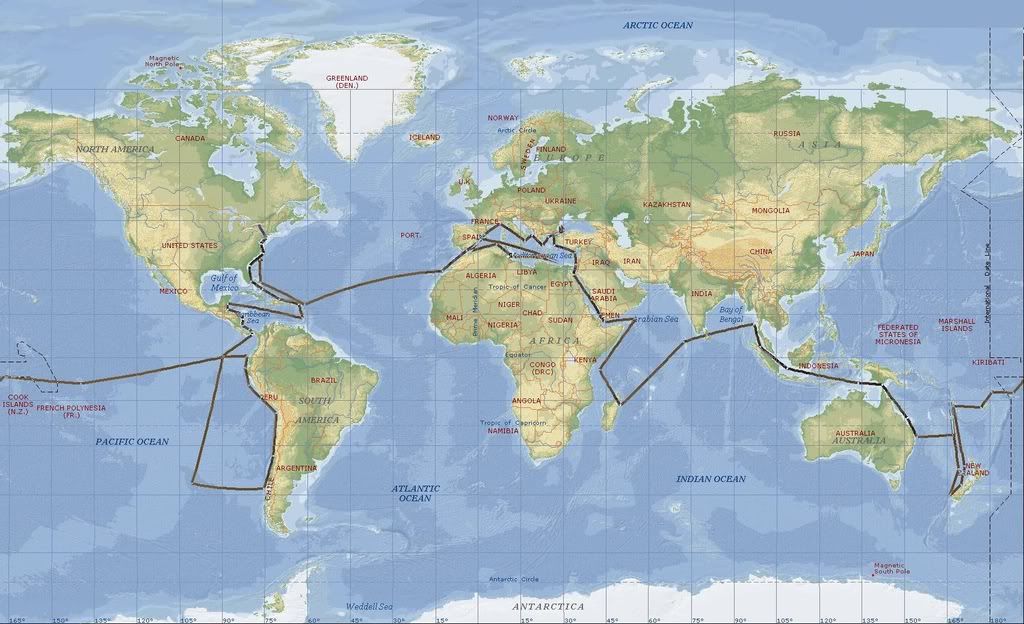
As Roger explained before we are heading toward Australia, North Queensland in order to fix the boat and pass the hurricane region before the end of September. Faster we go faster we’ll get the boat fixed and slower the rest of the ride will be. We’re now at night 3 about 300 miles from Vanuatu. I went to bed, it’s 8:00pm, and Roger woke me up because the hydraulic autopilot was not working anymore. We had problems with the other autopilot, the ST4000, as well since this one is eating our driving belts like crazy. We had 4 new driving belts delivered in Tahiti and 2 already broke. So we put the ST4000 on and guess what? It broke the belt. Waves were about 4 meters high and the poor ST4000 couldn’t make it through. I have to mention that except for sleeping Roger stays in the cockpit during our passages because he gets seasick inside the boat. So I found myself steering the boat by hand and Roger inside emptying the port side bed in the middle of big waves and trying to figure out what was wrong with the hydraulic autopilot. Meanwhile I am at the wheel and of course it starts raining on me with the wind from the stern and with the big rain I got soaked in less than a minute. So I am at the wheel freezing to death and Roger is down below sweating and seasick trying to get the thing back on track. After a while he came outside and said “I have to take the motor of the hydraulic RAM apart!” By then it was almost midnight and I said “Wait a minute we can’t take that poppy apart in the middle of the night and exhausted so let’s just steer by hand for the night and check it tomorrow morning.” I managed to put the ST4000 autopilot on but waves were crashing and pushing so hard on the boat that the autopilot could turn port side but when it came to starboard we heard tack-a-tack-a-tack-a-tack and the boat didn’t turn so we had to stay at the wheel and help the autopilot to turn starboard every 10 seconds. So Roger said “Ok let’s do only 2 hours shifts” and I said “Ok you go sleep and I go after you.” Around 7:00am Roger had slept about 3 ½ hours and so did I. I said to Roger “I can’t barely steer the boat even with the help I am giving the autopilot.” Roger said “I think the belt is broken again we have one left so we will change it.” But to change the belt you have to remove the wheel. How am I supposed to steer the boat without a wheel? We usually put the hydraulic autopilot on but this time …. Ok, let’s close the sails and we’ll float around while you change the belt. And so we did. Start the engine and try to control a bit the boat with the engines, OK it’s working! Change the belt and restart the autopilot; tack-a-tack-a-tack-a-tack can’t make it through the waves even under engines. “Ok then I’ll steer again” I said. Roger went down below and worked about 2 hours on the motor, opened it and cleaned it. During this time I am in the cockpit steering by hand and imagining us for another 20 or so hours steering by hand. But guess what? Roger came back from downstairs completely naked, all wet from sweating, white face and red eyes and said “Put it on it will work.” I love that man, I thought. It worked like a brand new one autopilot. Conclusion; if you want to be safe at sea take Roger along with you. Although I doubt he will be willing for another trip like this one!!!
I will not mention all the repairs and fixings we have to go through again once we reach Cairns in Australia but take a look at the cost page for the month of August and you’ll see what it means!

Tuesday, July 13, 2010

Arrived in Fiji

We arrived at the town of Savusavu on the island of Vanua Levu in Fiji, from Samoa, on July 12th, 2010 after a passage of 574 nautical miles (1068 Km) that took us 4 days and 3 hours for an overall average speed of 5.8 knots. It was a relatively smooth ride if it wasn’t of the rainstorm we encountered during our trip and yet another piece of our boomvang that snapped. Fortunately the storm lasted only about 2 hours and the wind gusts were only up to 27 knots so nothing to be too worried about other than the fact that the cockpit was all wet after that. As of the boomvang it seems that this is the story of our life in the Pacific. Every pieces of this equipment break one after the other, even the main cable, which was rated for up to 16,000 lbs, snapped on our last passage to Samoa. There is so much tension in this equipment that every time something breaks it comes with such a huge BANG that Danielle now calls it the boombang! This time it was the shackle holding the base of the lower block that snapped from fatigue. It took only 10 minutes to fix but this is really getting on our nerves. The plan is to change the whole thing once in Australia with much stronger parts in the hope that after that we will be able to straighten our main sail without worrying that the whole thing falls apart at every wave! On a different topic we hope you find our courtesy flags nice for since Panama we stopped buying the flags and started making them ourselves with our turbo Sailrite sewing machine. Fiji was quite a challenge and the result may not be perfect but, all things considered, is not too bad.One last thing to tickle your brain. We left Samoa on July 7th, 2010 and arrived 4 days later on July 12th, 2010. Do the math and you’ll see that something is wrong. The reason is that during this passage we crossed the date change line (180° longitude) and since we were sailing west we never saw the day of July 9th, 2010. Since we cannot travel in time the question you have to answer is where did this day go? Please send us an email with the answer. For the purists let’s assume we crossed the line at exactly midnight, but this is semantic.

Monday, July 12, 2010

Samoa is wonderful but be careful!

Samoa is a small country in South Pacific made of many islands but the vast majority of the population is concentrated on the biggest two islands; Utopu and Savaii. We stopped at the town of Apia on the island of Utopu and took a guided tour to visit de many waterfalls and to be explained the local culture and customs, which are quite different than ours. Strong family life, predominant religion and a joie de vivre you can only find in places where capitalism and over consumption have not yet left their trail of devastation. The visit was quite pleasant and we let ourselves go to wear small flowers on our ear and admire the nature. However I didn’t go as far as wearing one of these skirts, the lavalavas, men regularly wear down here. On this subject, the first day we arrived I went to the bank to change money while Danielle stayed on the boat. A man came to me to sell me those famous lavalavas. I looked in his bag and thought that he was definitively talking to the wrong person so I said no thanks. A few steps further I finally saw a policeman wearing a uniform made up of a shirt with a tie, sandals and … a skirt! I think I’ll send the Montreal Police Corps a suggestion to see what they think!

Here’s a picture of our guide Andrew (Andi for the friends) demonstrating how people around here play those popular wooden drums. We must admit that he gave us a pretty good tour, speaking good English sure helped, but it as at the end that the cream turned sour. At each places we went, waterfalls or other points of interest, we had to pay a small fee between 5 and 10 talas, which is the local currency (1 tala = $0.40), per person and this was fine. However, at the last waterfall our dear Andi knitted a fine story about the fact that at this place there was nobody to collect the money but we had to pay him instead and he would go pay later since the control was made apparently through a camera on site. I know that told like this the story is not very credible but, without going into lengthy details, let’s say that he was very good at making it so. Us, true to ourselves, we felt for it and gave him the 40 talas ($16) he asked for. Just to give you an idea he even went as far as inviting us to his house the next Sunday for a lunch with his family members and all the rest of it. Back to the boat we checked and sure enough the waterfall in question was obviously free! And since it is easier to convince a politician that world peace is an important thing than getting money back from a Samoan we simply let it go. Of course, we never went to his “lunch”, which was very likely another scam of his to get something out of us. So, if you come to Samoa have a good time and just avoid taking Andrew as a guide or a taxi driver.

Here’s another picture of the waterfall we are photographed in front of at the beginning of this post. Unfortunately, without another reference point it is hard to see how high this fall really was. The place was splendid with lush topical vegetation everywhere and this huge column of water falling. Seeing the flat rock at the top of the fall Danielle was wondering how it would be to dive from that point into the fall. Unfortunately, I’d left my swimsuit in the car and was not able to show my virility to her that day!


Here are a few pictures of Apia. Children here really like to be taken in picture and as soon as I pulled out my camera these young girls started to shout for me to point the device at them. We obviously went to the central market to buy fruits and vegetables. Prices are quite low, especially compared to French Polynesia, and the choice reasonably good. One interesting thing about the markets in the islands is that there are many people selling their products but the products are same on every stall. You can also see here a view of the large Catholic Church in the center of Apia, which is a landmark hard to miss when taking a walk in town. By the way, it is quite pleasant to walk in Apia. It is not very big but, other than the taxi drivers who you must watch, people are extremely nice and convivial.
One last note about our itinerary. If you read so far in this article you are probably one of our regular readers and in the next few weeks you will notice a tangible acceleration in our progress through the Pacific. The reason is quite simple. We had two choices for our Pacific passage. We could take our time and go to hide in New Zealand for the cyclone season, which starts around October, or speed up and leave Australia before the beginning of the cyclones. In the former case we’d have had to stay almost six months in New Zealand and get to South East Asia a year later. The latter scenario takes us through Fiji and Vanuatu and makes us to miss Tonga and New Zealand but shorten the trip by one full year. If you consult our cost page you will quickly understand why we chose this second scenario even though we are really sad of missing to visit such nice countries that are Tonga and New Zealand. One thing we realized in this trip is that the world is immense and it is impossible to see it all especially with the means we have. Nevertheless, we see many extraordinary things often beautiful but sometimes ugly and we are quite happy to have ventured into this trip and this even though we deeply miss Canada and the people we love.

Saturday, July 3, 2010

Arrived in Samoa

We arrived in the Western Samoa in the port of Apia on the island of Upolu after a nice passage of 1179 nautical miles (2193Km) that took us 9 days and 1 hour from Bora Bora in French Polynesia. The funny thing is the 1 hour in question was cancelled by the fact that Samoa is one hour behind Bora Bora and therefore we arrived at the same hour we left 10:20am. Our original plan was to stop in the middle at the atoll of Suvarov, which is part of the Cook Islands, but the wind direction and the fact we were making very good progress made us change our plans and we simply went straight to Samoa.

Friday, June 18, 2010

Raiatea, Tahaa and Bora Bora.

Leaving Tahiti in direction of Bora Bora we had a small stop to do at the island of Raiatea in order to do some repairs on the boat. Nothing major but the main task consisted in changing the blades of our starboard propeller and for this we needed to haul out the boat. Less than two hours after being out of the water the propeller had three new shiny blades but less than 48 hours after returning in the salt water the blades were already faded and the corrosion process well engaged! While waiting for our haul out at the dock of the “Chantier Maritime des Iles sous le vent” we chatted with Patrick and Naya who were moored just next to us. Naya mentioned among other things that she had some issues receiving her emails and Danielle told her she would come later to see what she can do. The next day, after we were done with the repairs and had launched the boat, we went to see them. We stayed four hours on their boat; 15 minutes for Danielle to fix the email problem and 3 hours and 45 minutes to chat with them!

Before leaving Raiatea we went to the neighbor island of Tahaa. In fact the two islands are so close that they share the same coral belt. We wanted to visit a pearl farm since the black pearl is literally the jewel of French Polynesia and the pun is entirely intended J Carl, from the “Motu Pearl Village” explained to us how they implant a small seed in the oysters to provoke the creation of a pearl. Eighteen months after the implant the oyster has covered the seed with a layer of black mother-of-pearl sufficiently thick to meet the regulations required to put it on the market. To give you an idea of the local pearl industry the farm we visited had, at one point, up to 200,000 oysters but the recent downturn in the pearl industry forced them to bring that figure down to 20,000. There are apparently around 650 pearl farms in French Polynesia. As for us since it was Danielle’s birthday and our wedding anniversary both in the same week we bought her a nice black pearl, the size of our means, she will be able to wear at the neck.

We couldn’t leave French Polynesia without seeing the island of Bora Bora. The water in the area is obviously magnificent but the island itself doesn’t have much for the passing tourists. The reason is very simple; Bora Bora is the paradise of De Luxe All Inclusive Resorts, which offer rooms starting around $150/night up to the bungalows built on piles going for as much as $850/night! People come here for the water and fishes are beautiful. We went snorkeling close to our anchorage at a place we saw many tour boats bringing tourists for a dive. While attaching our dinghy to a mooring ball at the location in question we saw hundreds of fishes gathering around us. It didn’t take us long to understand that those fishes are regularly fed by the tourist boats. We quickly came back to the boat and brought back a baguette of bread with us. As soon as we were in the water it was close to a thousand fishes that surrounded us from everywhere and we only had to hold the pieces of bread in our hand for them to come and nibble at it. We could even feel the tickling from some of them confusing our fingers with the bread. In few minutes the whole baguette was gone and not a single crumb touched the bottom!

Wednesday, June 9, 2010

Dazzled by Moorea.

We found Tahiti very nice but we were completely dazzled by Moorea its neighbor island. The main reason that attracted us to Moorea was to swim with dolphins at the Hotel Intercontinentale of Moorea. We didn’t have much trouble finding the de luxe hotel since its bungalows built on piles over the water of the lagoon were visible five miles around. When we arrived on the site we understood why the swimming session with the dolphins cost $550.00 for the two of us! The place was a five star resort with flowers and palm trees everywhere. We were ahead of time so we took a walk around the complex. It was not very hard since we had the title tourists tattooed in our forehead. This is something we encounter everywhere we go. With my “Tilley” hat, I need to wear all the time or otherwise being burnt to a cinder by the sun, and the rest of our cloths people immediately know we are tourists. Even here, where we could theoretically pass as French people living on the island, we get almost systematically greeted in English even after we answered in French. They must think that our Canadian accent is the one of an English tourist desperately trying to speak French to be polite! Anyhow, we were there to live this amazing experience we won’t likely have the chance to do again in our life. The two dolphins, born in captivity and very well trained, played with us by making flips, letting us pet them and taking different poses for the pictures. It is quite hard to describe in details how we felt but we keep a magic memory of this activity. As for the dolphins seeing us jumping in the water with our life jackets and diving masks they must have been thinking; “Why in the world am I still doing this job? Oh well, as long as I still get the fishes I can very well do their flips if this pleases them!”
This island of Moorea is the little neighbor of Tahiti and doesn’t seem exceptional at first. Like all French Polynesian islands it is a volcanic island surrounded by a coral belt. Eventually, the island will sink leaving only the coral belt in which case it will become an atoll. But this will take a few million years so land owners are not about to lose their investment any time soon! But the thing to know is that between the island, coming out of the water, and the coral belt reaching just below the surface there is channel of deeper waters in which small boats can navigate; this is what people call here the lagoon and this is exactly where we anchored Chocobo.
The water surrounding Moorea is the clearest water we saw so far in this trip. In the morning, when the wind is almost dead, we can see the bottom of the water but not the surface. Once we dove from the boat but had no reference to when we would hit the surface. This was kind of weird. But with such clear water you can imagine what the snorkeling might be. The coral reef is very healthy and populated by a multitude of fishes wearing colors to spin the head of tropical aquariums lovers. The aquarium here is right under the boat. We put our fins, masks and snorkelers and jump in the water. We swim a bit and we’re already at the coral belt. We even saw Nemo in his anemone! We went to three places in Moorea, Vaiare, la Baie de Cook and la Baie d’Opunohu. The last two were very nice but Vaiare beats them hollow. On the west side of the trench, located south of the pass, we found an underwater cliff that took our breath away. Fortunately, we had our snorkelers so we didn’t drown :-)
Waters of Moorea may make us feel in paradise but the island itself has its charm as well. With a light population; vegetation is everywhere. People are nice, like pretty much everywhere we go, and seem to live a peaceful life with not much stress. But like this man, who kindly volunteered to bring us back to Vaiare harbor in his car, told us they have concerns of their own. Speaking French with an accent to embarrass even people from Lake St-Jean he explained us that people were increasingly concerned by the growing usage of herbicides in the pineapple culture, which now pollutes the rivers and will eventually damage the corals. It seems that even in paradise productivity has its importance! I am sure God must be concern of the impact of the harp mass production on the clouds of the heavens!
One of things we wanted to see here in Moorea is what the locals call “la cascade”. It is a waterfall running on the side of the mountain and according to the tourist flyer is worth the trip. Starting at a small road behind the village school in Afareaitu we were told by the town people that we had to go to the end of the road and take the path on the right to get there. No direction signs the waterfall is there and you must find it! Luckily for us when we arrived at the path in question a group of people from the area got out of their car and took the path. It wasn’t obvious that this was our path and looking at each other we thought that if some people were going this way this must be our way too. Don’t try to find the logic here but it worked. After one or two hundred meters we caught up with them and they confirmed that this was the right way to la cascade. But later the path split in two and we had to use their help again to know that we had to take the path on the right. After an hour walk in the woods we finally reached the cascade and it was indeed worth the trip. Danielle had carefully prepared sandwiches and we had a nice picnic at the foot of the waterfall before leaving. The thing was though that the cascade was an hour walk from Afareaitu but our boat was in Vaiare, which was another hour walk from Afareaitu. When we arrived back to Afareaitu we were already walking for three hours. This is when the man I talked about in the previous paragraph honk at us and offered us a ride back to Vaiare. Of course we were not hard to convince to accept his offer!

Saturday, May 29, 2010

Charmed by Tahiti.


Even with our mooring incident at the Quai des Yachts we still have been charmed by the spell of Tahiti. While coming back from the supermarket, where prices are such they should run a credit check on the customers before letting them in, we arrived at the beginning of a very exotic ceremony taking place on the waterfront near the docks where we were moored. Five pirogues of the pure Polynesian style arrived in Tahiti from all the different corners of Polynesia and as far as New Zealand. The event seemed to reproduce the voyages and probably migrations of the ancients. The Pirogues, all sails opened, entered the port of Papeete and were greeted by the call of a Tahitian woman sending her welcome through a large cone to amplify her voice. Well, I say welcome but since everything was in Tahitian she could have said “Go back home we don’t want you here!” and to our ears we wouldn’t have been able to see the difference. However, the tone of her voice, which seemed to sing, and the rhythm of the six giant drums slammed by six Polynesian men with their bare torso and the arms covered of typical Polynesian tattoos and wearing folkloric costumes gave us a clear hint that the travelers were welcomed! The pirogues’ crews went ashore and were greeted by the city officials then followed a sequence of dance shows and oratory performances by the hosts of the ceremony as well as the crews who prepared for the occasion.
In addition to the Museum of Tahiti and the islands we visited a place called the Lagunarium. It is basically a set of small basins built by the “Captain Bligh” bar and restaurant containing rays, sharks and other local fishes. The basins are separated by an underwater structure reaching the bottom in which we can see the fishes underwater through a glass. Nope we were not diving when we took the picture of the shark but behind a very thick glass!
But the highlight of our visits in Tahiti was by all means the dinner and show we paid ourselves $$$$$ at the Beachcomber Hotel Intercontinental. With a five star buffet, consisting mainly of all kink of sea food, we also had a show of dances and songs produced by Les Grand Ballets de Tahiti. Trust me when I say you’ve never seen a girl swinging her hips until you saw the Tahiti dancers. I have no idea which muscles they use to do that but they use them a lot! The men for their part didn’t swing their hips but arms and legs were everywhere. When 10 Polynesians male dancers, all tattooed and most of them with pecs of steel, dance on the feverish rhythm of the drums they move a lot of air!
After the show the dancers were available to take pictures with the crowd. The show and the dinner were maybe not cheap but the food was to die for and the show very impressive. Should you ever come to Tahiti don’t cheap out and pay yourselves this show, you won’t be disappointed.