


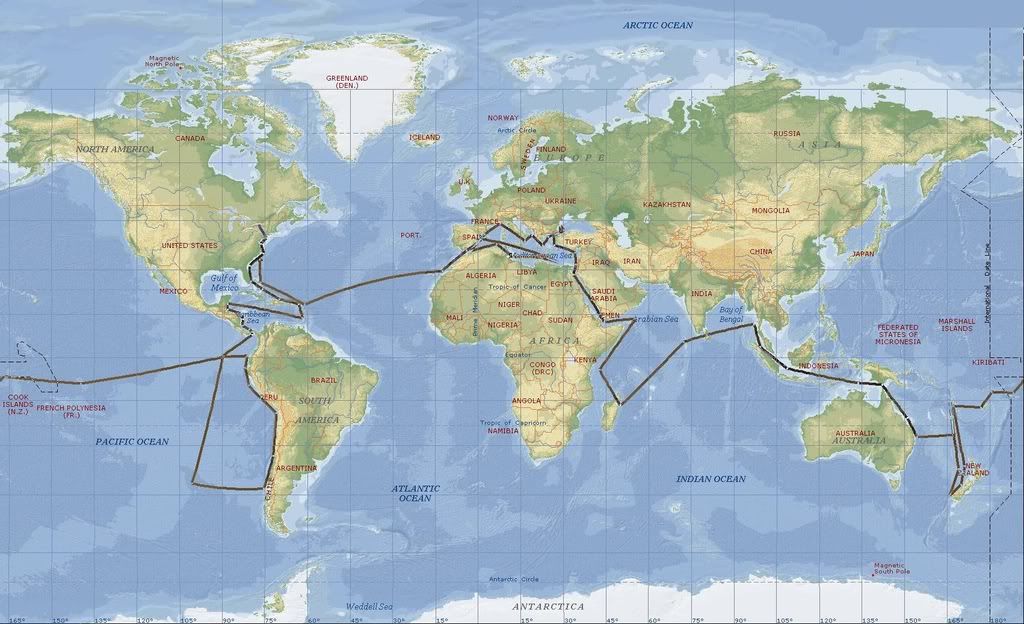
 We arrived in the Western Samoa in the port of Apia on the island of Upolu after a nice passage of 1179 nautical miles (2193Km) that took us 9 days and 1 hour from Bora Bora in French Polynesia. The funny thing is the 1 hour in question was cancelled by the fact that Samoa is one hour behind Bora Bora and therefore we arrived at the same hour we left 10:20am. Our original plan was to stop in the middle at the atoll of Suvarov, which is part of the Cook Islands, but the wind direction and the fact we were making very good progress made us change our plans and we simply went straight to Samoa.
Saturday, July 3, 2010
Arrived in Samoa
We arrived in the Western Samoa in the port of Apia on the island of Upolu after a nice passage of 1179 nautical miles (2193Km) that took us 9 days and 1 hour from Bora Bora in French Polynesia. The funny thing is the 1 hour in question was cancelled by the fact that Samoa is one hour behind Bora Bora and therefore we arrived at the same hour we left 10:20am. Our original plan was to stop in the middle at the atoll of Suvarov, which is part of the Cook Islands, but the wind direction and the fact we were making very good progress made us change our plans and we simply went straight to Samoa.
Friday, June 18, 2010
Raiatea, Tahaa and Bora Bora.

 Leaving Tahiti in direction of Bora Bora we had a small stop to do at the island of Raiatea in order to do some repairs on the boat. Nothing major but the main task consisted in changing the blades of our starboard propeller and for this we needed to haul out the boat. Less than two hours after being out of the water the propeller had three new shiny blades but less than 48 hours after returning in the salt water the blades were already faded and the corrosion process well engaged! While waiting for our haul out at the dock of the “Chantier Maritime des Iles sous le vent” we chatted with Patrick and Naya who were moored just next to us. Naya mentioned among other things that she had some issues receiving her emails and Danielle told her she would come later to see what she can do. The next day, after we were done with the repairs and had launched the boat, we went to see them. We stayed four hours on their boat; 15 minutes for Danielle to fix the email problem and 3 hours and 45 minutes to chat with them!
 Before leaving Raiatea we went to the neighbor island of Tahaa. In fact the two islands are so close that they share the same coral belt. We wanted to visit a pearl farm since the black pearl is literally the jewel of French Polynesia and the pun is entirely intended J Carl, from the “Motu Pearl Village” explained to us how they implant a small seed in the oysters to provoke the creation of a pearl. Eighteen months after the implant the oyster has covered the seed with a layer of black mother-of-pearl sufficiently thick to meet the regulations required to put it on the market. To give you an idea of the local pearl industry the farm we visited had, at one point, up to 200,000 oysters but the recent downturn in the pearl industry forced them to bring that figure down to 20,000. There are apparently around 650 pearl farms in French Polynesia. As for us since it was Danielle’s birthday and our wedding anniversary both in the same week we bought her a nice black pearl, the size of our means, she will be able to wear at the neck.
 We couldn’t leave French Polynesia without seeing the island of Bora Bora. The water in the area is obviously magnificent but the island itself doesn’t have much for the passing tourists. The reason is very simple; Bora Bora is the paradise of De Luxe All Inclusive Resorts, which offer rooms starting around $150/night up to the bungalows built on piles going for as much as $850/night! People come here for the water and fishes are beautiful. We went snorkeling close to our anchorage at a place we saw many tour boats bringing tourists for a dive. While attaching our dinghy to a mooring ball at the location in question we saw hundreds of fishes gathering around us. It didn’t take us long to understand that those fishes are regularly fed by the tourist boats. We quickly came back to the boat and brought back a baguette of bread with us. As soon as we were in the water it was close to a thousand fishes that surrounded us from everywhere and we only had to hold the pieces of bread in our hand for them to come and nibble at it. We could even feel the tickling from some of them confusing our fingers with the bread. In few minutes the whole baguette was gone and not a single crumb touched the bottom!
Wednesday, June 9, 2010
Dazzled by Moorea.
 We found Tahiti very nice but we were completely dazzled by Moorea its neighbor island. The main reason that attracted us to Moorea was to swim with dolphins at the Hotel Intercontinentale of Moorea. We didn’t have much trouble finding the de luxe hotel since its bungalows built on piles over the water of the lagoon were visible five miles around. When we arrived on the site we understood why the swimming session with the dolphins cost $550.00 for the two of us! The place was a five star resort with flowers and palm trees everywhere. We were ahead of time so we took a walk around the complex. It was not very hard since we had the title tourists tattooed in our forehead. This is something we encounter everywhere we go. With my “Tilley” hat, I need to wear all the time or otherwise being burnt to a cinder by the sun, and the rest of our cloths people immediately know we are tourists. Even here, where we could theoretically pass as French people living on the island, we get almost systematically greeted in English even after we answered in French. They must think that our Canadian accent is the one of an English tourist desperately trying to speak French to be polite! Anyhow, we were there to live this amazing experience we won’t likely have the chance to do again in our life. The two dolphins, born in captivity and very well trained, played with us by making flips, letting us pet them and taking different poses for the pictures. It is quite hard to describe in details how we felt but we keep a magic memory of this activity. As for the dolphins seeing us jumping in the water with our life jackets and diving masks they must have been thinking; “Why in the world am I still doing this job? Oh well, as long as I still get the fishes I can very well do their flips if this pleases them!”
 This island of Moorea is the little neighbor of Tahiti and doesn’t seem exceptional at first. Like all French Polynesian islands it is a volcanic island surrounded by a coral belt. Eventually, the island will sink leaving only the coral belt in which case it will become an atoll. But this will take a few million years so land owners are not about to lose their investment any time soon! But the thing to know is that between the island, coming out of the water, and the coral belt reaching just below the surface there is channel of deeper waters in which small boats can navigate; this is what people call here the lagoon and this is exactly where we anchored Chocobo.
 The water surrounding Moorea is the clearest water we saw so far in this trip. In the morning, when the wind is almost dead, we can see the bottom of the water but not the surface. Once we dove from the boat but had no reference to when we would hit the surface. This was kind of weird. But with such clear water you can imagine what the snorkeling might be. The coral reef is very healthy and populated by a multitude of fishes wearing colors to spin the head of tropical aquariums lovers. The aquarium here is right under the boat. We put our fins, masks and snorkelers and jump in the water. We swim a bit and we’re already at the coral belt. We even saw Nemo in his anemone! We went to three places in Moorea, Vaiare, la Baie de Cook and la Baie d’Opunohu. The last two were very nice but Vaiare beats them hollow. On the west side of the trench, located south of the pass, we found an underwater cliff that took our breath away. Fortunately, we had our snorkelers so we didn’t drown :-)
 Waters of Moorea may make us feel in paradise but the island itself has its charm as well. With a light population; vegetation is everywhere. People are nice, like pretty much everywhere we go, and seem to live a peaceful life with not much stress. But like this man, who kindly volunteered to bring us back to Vaiare harbor in his car, told us they have concerns of their own. Speaking French with an accent to embarrass even people from Lake St-Jean he explained us that people were increasingly concerned by the growing usage of herbicides in the pineapple culture, which now pollutes the rivers and will eventually damage the corals. It seems that even in paradise productivity has its importance! I am sure God must be concern of the impact of the harp mass production on the clouds of the heavens!
 One of things we wanted to see here in Moorea is what the locals call “la cascade”. It is a waterfall running on the side of the mountain and according to the tourist flyer is worth the trip. Starting at a small road behind the village school in Afareaitu we were told by the town people that we had to go to the end of the road and take the path on the right to get there. No direction signs the waterfall is there and you must find it! Luckily for us when we arrived at the path in question a group of people from the area got out of their car and took the path. It wasn’t obvious that this was our path and looking at each other we thought that if some people were going this way this must be our way too. Don’t try to find the logic here but it worked. After one or two hundred meters we caught up with them and they confirmed that this was the right way to la cascade. But later the path split in two and we had to use their help again to know that we had to take the path on the right. After an hour walk in the woods we finally reached the cascade and it was indeed worth the trip. Danielle had carefully prepared sandwiches and we had a nice picnic at the foot of the waterfall before leaving. The thing was though that the cascade was an hour walk from Afareaitu but our boat was in Vaiare, which was another hour walk from Afareaitu. When we arrived back to Afareaitu we were already walking for three hours. This is when the man I talked about in the previous paragraph honk at us and offered us a ride back to Vaiare. Of course we were not hard to convince to accept his offer!
Saturday, May 29, 2010
Charmed by Tahiti.


Even with our mooring incident at the Quai des Yachts we still have been charmed by the spell of Tahiti. While coming back from the supermarket, where prices are such they should run a credit check on the customers before letting them in, we arrived at the beginning of a very exotic ceremony taking place on the waterfront near the docks where we were moored. Five pirogues of the pure Polynesian style arrived in Tahiti from all the different corners of Polynesia and as far as New Zealand. The event seemed to reproduce the voyages and probably migrations of the ancients. The Pirogues, all sails opened, entered the port of Papeete and were greeted by the call of a Tahitian woman sending her welcome through a large cone to amplify her voice. Well, I say welcome but since everything was in Tahitian she could have said “Go back home we don’t want you here!” and to our ears we wouldn’t have been able to see the difference. However, the tone of her voice, which seemed to sing, and the rhythm of the six giant drums slammed by six Polynesian men with their bare torso and the arms covered of typical Polynesian tattoos and wearing folkloric costumes gave us a clear hint that the travelers were welcomed! The pirogues’ crews went ashore and were greeted by the city officials then followed a sequence of dance shows and oratory performances by the hosts of the ceremony as well as the crews who prepared for the occasion.

 In addition to the Museum of Tahiti and the islands we visited a place called the Lagunarium. It is basically a set of small basins built by the “Captain Bligh” bar and restaurant containing rays, sharks and other local fishes. The basins are separated by an underwater structure reaching the bottom in which we can see the fishes underwater through a glass. Nope we were not diving when we took the picture of the shark but behind a very thick glass!
 But the highlight of our visits in Tahiti was by all means the dinner and show we paid ourselves $$$$$ at the Beachcomber Hotel Intercontinental. With a five star buffet, consisting mainly of all kink of sea food, we also had a show of dances and songs produced by Les Grand Ballets de Tahiti. Trust me when I say you’ve never seen a girl swinging her hips until you saw the Tahiti dancers. I have no idea which muscles they use to do that but they use them a lot! The men for their part didn’t swing their hips but arms and legs were everywhere. When 10 Polynesians male dancers, all tattooed and most of them with pecs of steel, dance on the feverish rhythm of the drums they move a lot of air!
 After the show the dancers were available to take pictures with the crowd. The show and the dinner were maybe not cheap but the food was to die for and the show very impressive. Should you ever come to Tahiti don’t cheap out and pay yourselves this show, you won’t be disappointed.
Friday, May 28, 2010
Our arrival in Tahiti.
 After our brief stop in the Tuamotu we set course to the Society Islands and for our first stopover we chose the most known of them all namely; Tahiti and more precisely the town of Papeete. The island is simply charming. The town is clean and consequently expensive. However it is worth the expense. Not knowing the place we spent the first days at the Yacht Dock (Le quai des yachts) at the center of Papeete. Besides the fact that the docks are expensive, $50 per night, they had the brilliant idea of implementing a docking system quite popular in Europe called the Med Mooring. It may be routine for a European to use that system but for us North-American it was the first time we faced that monstrosity. In a nutshell it is a long dock to which we attach the stern of the boat on cleats located on the dock while the bow is attached to a heavy chain at the bottom of the water through mooring lines also underwater. To retrieve those mooring lines they attached them to smaller guide lines that run to the dock. The distance between each guide line is about 12 feet (4m) and since our boat is 21 feet (7m) wide we had one guide line on each side and of course one guide line in the middle under the boat. Any boat owner knows that the worst thing to have close to a boat while the propellers are running is precisely a line in the water! I was at the wheel while Danielle was taking care of grabbing the lines and attaching them. Everything was going well but the fact we had a side wind. Danielle caught the first guide line and rushed forward to attach the mooring line to the boat. But the maneuver took too long and the boat started to drift aside and the damn guide line started to push on the railing threatening to bind it. I had to do something but a boat, even with two engines, it doesn’t move sideways. All I could do was to turn the boat to release the pressure on the railing. With the mooring line already attached at the bow, the front of the boat stayed there while the stern started to move sideways. This is what I wanted but now we had a guide line running in the center of the boat and of course it caught itself in the rudder. I immediately stopped the propeller on that side and I ended up with one side of the boat attached at the front and a line stuck in the rudder and likely in the propeller as well! I told Danielle, Ok that’s it we stop everything. We untied the mooring line at the front and managed to position the boat on the side along the dock and to secure it in that position. I dove to inspect the propeller and sure enough the guide line was wrapped around it. Fortunately there were no damages and 10 minutes of work later the propeller was free. We tried a second time but this time we tied the stern lines to the dock first then I put the engine forward which kept the boat steady while we attached the mooring lines at the bow. But this was not the end of our misery. Danielle pulled quickly the guide lines being very careful not to catch them in the running propellers. But she didn’t notice immediately that the damn line, invented by the devil himself, were covered with small razor sharp shells. After the mooring lines were properly attached and the boat well secured Danielle, who was on the verge of a nervous breakdown after a mooring procedure probably devised by the German experts in mental torture during WWII, stood on the deck with both hands in front of her with her blood gushing on her feet. Her fingers had been literally lacerated by the shells and were hemorrhaging. I ran inside and brought back bandages and some disinfectant. We cleaned the cuts thoroughly and stopped the bleeding. At the end the cuts were not very deep but there were many and it took a few days for Danielle to fully recover the usage of her hands. If I ever get my hand on the moron who came up with that system I think I’ll take his stupid shells covered line and wrap it around his balls!
Thursday, May 27, 2010
Disapointed by Rangiroa.
 The atoll of Rangiroa is one of the many forming the Tuamotu, one of the four sectors of French Polynesia along with the Marquesas, the Society Islands and the Austral Islands. We choose to stop here since it is the largest atoll in the Tuamotu and looked promising. An atoll is a string of islands formed by the coral reefs that surrounded an island long time ago. The island eventually sinks and disappears but the growing coral stays there and eventually the coral and it’s debris create islands that the locals call motus. No doubt that the place is gorgeous with sand beaches, palm trees and water clear enough to embarrass a Bahamian. (Bahamas have one of the clearest water in the world.) Our disappointment didn’t come from the environment but from the people. We anchored near the village of Tiputa and the nearby island has probably more tourists on it than locals. For that reason the locals have become “immune” to tourists and they don’t say hello, don’t smile and in some cases don’t even answer when you try to talk to them. It was a genuinely strange feeling as for the last year and a half we were used to find very nice and warm people everywhere we go. Snorkeling was nice. Just off the boat we had coral heads with very colorful fishes but unfortunately El Nino many years ago increased the water temperature by 2 or 3 degrees and all the corals turned white. A hurricane followed a few years later to finish the job. However, we briefly anchored in front of the village of Avatoru just 7 miles west of Tiputa and I dove to see if the anchor was set correctly since all we could see was coral. The tide was going down and the lagoon in the center of the atoll was emptying itself through the pass creating a very strong current. I managed to swim up to the bow of the boat but couldn’t go further so I let the current pull me back to the stern where I grabbed the hand railing just as I was passing by. I didn’t see the anchor but saw instead a carpet of coral spreading as far as I could see. The corals were the shape of a big flower and the number of different colors was staggering. Usually corals offer a limited number of colors at one place but here it was the whole rainbow spectrum. The current being so strong we couldn’t stay very long, and surely not in the water, so we left. Danielle didn’t see this coral but I for sure will remember it for a long time.
Saturday, May 8, 2010
Visit in the Marquesas
 The first thing striking us when arriving in the Marquesas was the majestic beauty of the landscape of these volcanic islands. Spat out from the center of the earth the lava rose above the sea level to create islands of splendid scenery on which grows lush vegetation. Well, once we recovered from the poetic beauty of the high cliffs and the palm trees we come back down to more down to earth realities such as the name of the different places here. For example, after our Pacific crossing we stopped in the village of Atuona on the island of Hiva Oa in the French department of Marquesas in French Polynesia. The Marquesas Islands have names such as Tahuata, Fatu Hiva or my favorite; Ua Pou. Those names obviously mean something to the people here but for us, poor mortals, it is just a sequence of sounds with no apparent meaning and consequently it is very difficult to remember them. Just to show us, without rereading the text, what is the name of the island where we first stopped? You can imagine what a conversation between sailors here looks like. “Do you plan to go at Hatutu?” the other, a bit perplex, answers “Hum, Hatutu, is it the island north of here next to Kaukura? Oh wait, Kaukura it’s in the Tuamotu Archipelago not in the Marquesas…” and so forth.
 But after three weeks at sea people who crossed the Pacific need to talk to other human beings. To talk about the crossing of course but also to talk, period. In Hiva-Oa we spent a lot of time socializing and the day we arrived we were quite happy to see again our friends Dominique and Malou on board their 65 foot (20m) catamaran Cata Fjord who we first met in St-Georges, Grenada. You can see them here on the left picture. Dominique and Malou are smart and extremely friendly people. Danielle and I can spend 5 or 6 hours straight talking with them and feeling we just started the conversation! We spent a lot of time with them, over a dinner and later for breakfast, talking about boats and solving the problems of the world. Unfortunately, our itinerary being faster than their we simply don’t know when we will be able to see them again. On the center picture and the one on the right you can see Max and Peter two Australians on board the sailboat Yanada whom we met in the Galapagos. They had issues in clearing in the country and we were able to help them with this. Speaking French in French Polynesia really helps when comes the time to sort out the different options offered to us to pay the infamous bond imposed by the authorities, which forces foreigners to either have a return plane ticket or to pay a bond corresponding to the cost of a plane ticket back to your home country. The value of the bond is then returned to you once you leave the country. I give you the short version of the story here but things are much more complicated, and expensive, than it looks like when it comes to the bond. Later we had a very good time spending an evening on board Yanada and twisting our ears trying to catch the Australian accent and expressions. Let’s say it is quite a feat to follow a conversation with Peter after the wine poured for three hours! Like with Cata Fjord our route now split from Yanada’s and we may see Peter and Max again only once we get to Australia. This is the sad reality of the life on a boat. We meet many nice people then one day on the snap of the fingers we must wave them good bye and there’s only emails left to keep in touch with them.
In Hiva-Oa we took a guided tour of the island during which we mainly visited the magnificent landscape but we also had a lunch in one of the local restaurant where we enjoyed a good sample of the Polynesian gastronomy. Let’s simply say that dishes were very good and Polynesian women really know how to cook. This becomes quite obvious when we take a look at the bellies of their husbands! On the picture you can see, at the center, a plate of shrimps on spinach in coconut milk surrounded by a dish of bread fruits with sweetened bananas, of raw fish in coco milk, of solidified fruit puree and rice.

During our visit of the island we went to see a ceremonial site where Polynesians, in the old days, carved the famous tikis those stone statues representing important people or an important moment in life such as here on the right picture where we can see the statue of a woman giving birth. From her look the baby must have been quite huge maybe the warrior we see in the background of the picture on the left! By the way I am not crouching to look at the baby in question but to observe the carvings at the base of the statue!

In Hiva-Oa are buried two famous people; the author and interpret Jacques Brel and the master painter Paul Gauguin. Jacques Brel, born in Belgium, spent the last years of his life here and passed away prematurely in 1978 at the age of 49; thanks to the cigarette and the lung cancer that followed. Many of you may not know Brel who was a signer made vary famous in the French world by his very deep and poetic songs. The interpretation of his songs was profound and made with a very emotional control of the tones and tempos completely unique to him. If you haven’t heard Jacques Brel before go to the music store and buy one of his greatest hit albums, sit down and just listen. You may not understand the lyrics but just the way he sings will make you dream. One the plaque next to his grave we can read (my translation).
Passer-by,
Man of sails
Man of starts
This troubadour
Delighted our lives
From the North Sea
To the Marquesas
The poet,
From the blue of his eternity
Thank you
For your passage
A nice poem at the image of this great artist’s songs that make us travel in the imaginary of the reality painted in Brel’s unique style. I know that saying “the imaginary of the reality” may sounds a bit weird but one needs to listen Brel’s to understand what I mean.
As for Paul Gauguin he spent most of the time he was here drinking and upsetting the local authorities. I don’t really know Gauguin’s art so I don’t have much to say about him.
Man of sails
Man of starts
This troubadour
Delighted our lives
From the North Sea
To the Marquesas
The poet,
From the blue of his eternity
Thank you
For your passage
A nice poem at the image of this great artist’s songs that make us travel in the imaginary of the reality painted in Brel’s unique style. I know that saying “the imaginary of the reality” may sounds a bit weird but one needs to listen Brel’s to understand what I mean.
As for Paul Gauguin he spent most of the time he was here drinking and upsetting the local authorities. I don’t really know Gauguin’s art so I don’t have much to say about him.
 While in Marquesas it is hard not see once in a while one of these pirogues inspired from the ones used by the first colons coming from Asia long time ago. Wood gave way to the lighter fiberglass in their making but the people here seem to take the pirogues competitions very seriously and train regularly in the bay. As for Danielle she seems to be attracted by some of the rower’s build! Me, far from being jealous, reminded her that pecs and biceps are nice but having worked on a computer all my life I have very well developed fingers myself!
Subscribe to:
Posts (Atom)