


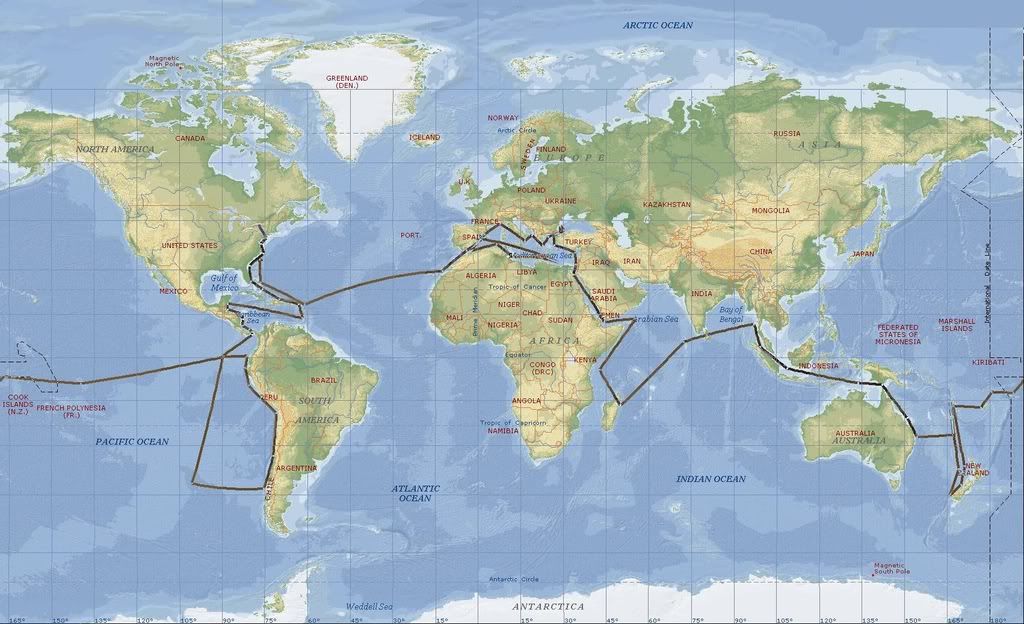
 After our brief stop in the Tuamotu we set course to the Society Islands and for our first stopover we chose the most known of them all namely; Tahiti and more precisely the town of Papeete. The island is simply charming. The town is clean and consequently expensive. However it is worth the expense. Not knowing the place we spent the first days at the Yacht Dock (Le quai des yachts) at the center of Papeete. Besides the fact that the docks are expensive, $50 per night, they had the brilliant idea of implementing a docking system quite popular in Europe called the Med Mooring. It may be routine for a European to use that system but for us North-American it was the first time we faced that monstrosity. In a nutshell it is a long dock to which we attach the stern of the boat on cleats located on the dock while the bow is attached to a heavy chain at the bottom of the water through mooring lines also underwater. To retrieve those mooring lines they attached them to smaller guide lines that run to the dock. The distance between each guide line is about 12 feet (4m) and since our boat is 21 feet (7m) wide we had one guide line on each side and of course one guide line in the middle under the boat. Any boat owner knows that the worst thing to have close to a boat while the propellers are running is precisely a line in the water! I was at the wheel while Danielle was taking care of grabbing the lines and attaching them. Everything was going well but the fact we had a side wind. Danielle caught the first guide line and rushed forward to attach the mooring line to the boat. But the maneuver took too long and the boat started to drift aside and the damn guide line started to push on the railing threatening to bind it. I had to do something but a boat, even with two engines, it doesn’t move sideways. All I could do was to turn the boat to release the pressure on the railing. With the mooring line already attached at the bow, the front of the boat stayed there while the stern started to move sideways. This is what I wanted but now we had a guide line running in the center of the boat and of course it caught itself in the rudder. I immediately stopped the propeller on that side and I ended up with one side of the boat attached at the front and a line stuck in the rudder and likely in the propeller as well! I told Danielle, Ok that’s it we stop everything. We untied the mooring line at the front and managed to position the boat on the side along the dock and to secure it in that position. I dove to inspect the propeller and sure enough the guide line was wrapped around it. Fortunately there were no damages and 10 minutes of work later the propeller was free. We tried a second time but this time we tied the stern lines to the dock first then I put the engine forward which kept the boat steady while we attached the mooring lines at the bow. But this was not the end of our misery. Danielle pulled quickly the guide lines being very careful not to catch them in the running propellers. But she didn’t notice immediately that the damn line, invented by the devil himself, were covered with small razor sharp shells. After the mooring lines were properly attached and the boat well secured Danielle, who was on the verge of a nervous breakdown after a mooring procedure probably devised by the German experts in mental torture during WWII, stood on the deck with both hands in front of her with her blood gushing on her feet. Her fingers had been literally lacerated by the shells and were hemorrhaging. I ran inside and brought back bandages and some disinfectant. We cleaned the cuts thoroughly and stopped the bleeding. At the end the cuts were not very deep but there were many and it took a few days for Danielle to fully recover the usage of her hands. If I ever get my hand on the moron who came up with that system I think I’ll take his stupid shells covered line and wrap it around his balls!
Friday, May 28, 2010
Our arrival in Tahiti.
After our brief stop in the Tuamotu we set course to the Society Islands and for our first stopover we chose the most known of them all namely; Tahiti and more precisely the town of Papeete. The island is simply charming. The town is clean and consequently expensive. However it is worth the expense. Not knowing the place we spent the first days at the Yacht Dock (Le quai des yachts) at the center of Papeete. Besides the fact that the docks are expensive, $50 per night, they had the brilliant idea of implementing a docking system quite popular in Europe called the Med Mooring. It may be routine for a European to use that system but for us North-American it was the first time we faced that monstrosity. In a nutshell it is a long dock to which we attach the stern of the boat on cleats located on the dock while the bow is attached to a heavy chain at the bottom of the water through mooring lines also underwater. To retrieve those mooring lines they attached them to smaller guide lines that run to the dock. The distance between each guide line is about 12 feet (4m) and since our boat is 21 feet (7m) wide we had one guide line on each side and of course one guide line in the middle under the boat. Any boat owner knows that the worst thing to have close to a boat while the propellers are running is precisely a line in the water! I was at the wheel while Danielle was taking care of grabbing the lines and attaching them. Everything was going well but the fact we had a side wind. Danielle caught the first guide line and rushed forward to attach the mooring line to the boat. But the maneuver took too long and the boat started to drift aside and the damn guide line started to push on the railing threatening to bind it. I had to do something but a boat, even with two engines, it doesn’t move sideways. All I could do was to turn the boat to release the pressure on the railing. With the mooring line already attached at the bow, the front of the boat stayed there while the stern started to move sideways. This is what I wanted but now we had a guide line running in the center of the boat and of course it caught itself in the rudder. I immediately stopped the propeller on that side and I ended up with one side of the boat attached at the front and a line stuck in the rudder and likely in the propeller as well! I told Danielle, Ok that’s it we stop everything. We untied the mooring line at the front and managed to position the boat on the side along the dock and to secure it in that position. I dove to inspect the propeller and sure enough the guide line was wrapped around it. Fortunately there were no damages and 10 minutes of work later the propeller was free. We tried a second time but this time we tied the stern lines to the dock first then I put the engine forward which kept the boat steady while we attached the mooring lines at the bow. But this was not the end of our misery. Danielle pulled quickly the guide lines being very careful not to catch them in the running propellers. But she didn’t notice immediately that the damn line, invented by the devil himself, were covered with small razor sharp shells. After the mooring lines were properly attached and the boat well secured Danielle, who was on the verge of a nervous breakdown after a mooring procedure probably devised by the German experts in mental torture during WWII, stood on the deck with both hands in front of her with her blood gushing on her feet. Her fingers had been literally lacerated by the shells and were hemorrhaging. I ran inside and brought back bandages and some disinfectant. We cleaned the cuts thoroughly and stopped the bleeding. At the end the cuts were not very deep but there were many and it took a few days for Danielle to fully recover the usage of her hands. If I ever get my hand on the moron who came up with that system I think I’ll take his stupid shells covered line and wrap it around his balls!
Thursday, May 27, 2010
Disapointed by Rangiroa.
 The atoll of Rangiroa is one of the many forming the Tuamotu, one of the four sectors of French Polynesia along with the Marquesas, the Society Islands and the Austral Islands. We choose to stop here since it is the largest atoll in the Tuamotu and looked promising. An atoll is a string of islands formed by the coral reefs that surrounded an island long time ago. The island eventually sinks and disappears but the growing coral stays there and eventually the coral and it’s debris create islands that the locals call motus. No doubt that the place is gorgeous with sand beaches, palm trees and water clear enough to embarrass a Bahamian. (Bahamas have one of the clearest water in the world.) Our disappointment didn’t come from the environment but from the people. We anchored near the village of Tiputa and the nearby island has probably more tourists on it than locals. For that reason the locals have become “immune” to tourists and they don’t say hello, don’t smile and in some cases don’t even answer when you try to talk to them. It was a genuinely strange feeling as for the last year and a half we were used to find very nice and warm people everywhere we go. Snorkeling was nice. Just off the boat we had coral heads with very colorful fishes but unfortunately El Nino many years ago increased the water temperature by 2 or 3 degrees and all the corals turned white. A hurricane followed a few years later to finish the job. However, we briefly anchored in front of the village of Avatoru just 7 miles west of Tiputa and I dove to see if the anchor was set correctly since all we could see was coral. The tide was going down and the lagoon in the center of the atoll was emptying itself through the pass creating a very strong current. I managed to swim up to the bow of the boat but couldn’t go further so I let the current pull me back to the stern where I grabbed the hand railing just as I was passing by. I didn’t see the anchor but saw instead a carpet of coral spreading as far as I could see. The corals were the shape of a big flower and the number of different colors was staggering. Usually corals offer a limited number of colors at one place but here it was the whole rainbow spectrum. The current being so strong we couldn’t stay very long, and surely not in the water, so we left. Danielle didn’t see this coral but I for sure will remember it for a long time.
Saturday, May 8, 2010
Visit in the Marquesas
 The first thing striking us when arriving in the Marquesas was the majestic beauty of the landscape of these volcanic islands. Spat out from the center of the earth the lava rose above the sea level to create islands of splendid scenery on which grows lush vegetation. Well, once we recovered from the poetic beauty of the high cliffs and the palm trees we come back down to more down to earth realities such as the name of the different places here. For example, after our Pacific crossing we stopped in the village of Atuona on the island of Hiva Oa in the French department of Marquesas in French Polynesia. The Marquesas Islands have names such as Tahuata, Fatu Hiva or my favorite; Ua Pou. Those names obviously mean something to the people here but for us, poor mortals, it is just a sequence of sounds with no apparent meaning and consequently it is very difficult to remember them. Just to show us, without rereading the text, what is the name of the island where we first stopped? You can imagine what a conversation between sailors here looks like. “Do you plan to go at Hatutu?” the other, a bit perplex, answers “Hum, Hatutu, is it the island north of here next to Kaukura? Oh wait, Kaukura it’s in the Tuamotu Archipelago not in the Marquesas…” and so forth.
 But after three weeks at sea people who crossed the Pacific need to talk to other human beings. To talk about the crossing of course but also to talk, period. In Hiva-Oa we spent a lot of time socializing and the day we arrived we were quite happy to see again our friends Dominique and Malou on board their 65 foot (20m) catamaran Cata Fjord who we first met in St-Georges, Grenada. You can see them here on the left picture. Dominique and Malou are smart and extremely friendly people. Danielle and I can spend 5 or 6 hours straight talking with them and feeling we just started the conversation! We spent a lot of time with them, over a dinner and later for breakfast, talking about boats and solving the problems of the world. Unfortunately, our itinerary being faster than their we simply don’t know when we will be able to see them again. On the center picture and the one on the right you can see Max and Peter two Australians on board the sailboat Yanada whom we met in the Galapagos. They had issues in clearing in the country and we were able to help them with this. Speaking French in French Polynesia really helps when comes the time to sort out the different options offered to us to pay the infamous bond imposed by the authorities, which forces foreigners to either have a return plane ticket or to pay a bond corresponding to the cost of a plane ticket back to your home country. The value of the bond is then returned to you once you leave the country. I give you the short version of the story here but things are much more complicated, and expensive, than it looks like when it comes to the bond. Later we had a very good time spending an evening on board Yanada and twisting our ears trying to catch the Australian accent and expressions. Let’s say it is quite a feat to follow a conversation with Peter after the wine poured for three hours! Like with Cata Fjord our route now split from Yanada’s and we may see Peter and Max again only once we get to Australia. This is the sad reality of the life on a boat. We meet many nice people then one day on the snap of the fingers we must wave them good bye and there’s only emails left to keep in touch with them.
In Hiva-Oa we took a guided tour of the island during which we mainly visited the magnificent landscape but we also had a lunch in one of the local restaurant where we enjoyed a good sample of the Polynesian gastronomy. Let’s simply say that dishes were very good and Polynesian women really know how to cook. This becomes quite obvious when we take a look at the bellies of their husbands! On the picture you can see, at the center, a plate of shrimps on spinach in coconut milk surrounded by a dish of bread fruits with sweetened bananas, of raw fish in coco milk, of solidified fruit puree and rice.

During our visit of the island we went to see a ceremonial site where Polynesians, in the old days, carved the famous tikis those stone statues representing important people or an important moment in life such as here on the right picture where we can see the statue of a woman giving birth. From her look the baby must have been quite huge maybe the warrior we see in the background of the picture on the left! By the way I am not crouching to look at the baby in question but to observe the carvings at the base of the statue!

In Hiva-Oa are buried two famous people; the author and interpret Jacques Brel and the master painter Paul Gauguin. Jacques Brel, born in Belgium, spent the last years of his life here and passed away prematurely in 1978 at the age of 49; thanks to the cigarette and the lung cancer that followed. Many of you may not know Brel who was a signer made vary famous in the French world by his very deep and poetic songs. The interpretation of his songs was profound and made with a very emotional control of the tones and tempos completely unique to him. If you haven’t heard Jacques Brel before go to the music store and buy one of his greatest hit albums, sit down and just listen. You may not understand the lyrics but just the way he sings will make you dream. One the plaque next to his grave we can read (my translation).
Passer-by,
Man of sails
Man of starts
This troubadour
Delighted our lives
From the North Sea
To the Marquesas
The poet,
From the blue of his eternity
Thank you
For your passage
A nice poem at the image of this great artist’s songs that make us travel in the imaginary of the reality painted in Brel’s unique style. I know that saying “the imaginary of the reality” may sounds a bit weird but one needs to listen Brel’s to understand what I mean.
As for Paul Gauguin he spent most of the time he was here drinking and upsetting the local authorities. I don’t really know Gauguin’s art so I don’t have much to say about him.
Man of sails
Man of starts
This troubadour
Delighted our lives
From the North Sea
To the Marquesas
The poet,
From the blue of his eternity
Thank you
For your passage
A nice poem at the image of this great artist’s songs that make us travel in the imaginary of the reality painted in Brel’s unique style. I know that saying “the imaginary of the reality” may sounds a bit weird but one needs to listen Brel’s to understand what I mean.
As for Paul Gauguin he spent most of the time he was here drinking and upsetting the local authorities. I don’t really know Gauguin’s art so I don’t have much to say about him.
 While in Marquesas it is hard not see once in a while one of these pirogues inspired from the ones used by the first colons coming from Asia long time ago. Wood gave way to the lighter fiberglass in their making but the people here seem to take the pirogues competitions very seriously and train regularly in the bay. As for Danielle she seems to be attracted by some of the rower’s build! Me, far from being jealous, reminded her that pecs and biceps are nice but having worked on a computer all my life I have very well developed fingers myself!
Friday, April 23, 2010
Arrived in French Polynesia
 We arrived at Atuona on the island of Hiva Oa in French Polynesia. We sailed 3050 nm from the Galapagos and took 22 days and 30 minutes.
We crossed the Pacific Ocean.

Well we’ve done it; we crossed the Pacific Ocean after our longest planned passage sailing non-stop 3050nm (5673 km) over 22 days and 30 minutes at an average speed of 5.8 knots (11km/hr). We started our passage from the Island of San Cristobal in the Galapagos Archipelago and reached, on the other end, the island of Hiva Oa in the Marquesas, French Polynesia. Many see that passage as a feat, a goal in their life. Although a few hundred people do the same trip every year we think we can say that we now made our entry into the very select club of ocean sailors. It sure is an adventure however not exactly what we would think at first. Spending three weeks at sea, when everything goes smooth, is not very difficult. In Curacao we met Gérard who crossed five times the Atlantic and asked him what it was like to travel all across an ocean. He look at us hesitantly then said “Well you know, giving the time a hay stack would cross the ocean anything that floats would eventually reach the other side. It is not that complicated more boring than anything else.” And he didn’t elaborate further. What we now understand is that the real challenge is not the crossing itself especially for the Pacific, which as its name implies is a pretty quiet body of water during the right season. The real challenge in fact is in getting to the starting point and leave. Think about it a minute. Before you actually cross the ocean you need to get a boat, fit it with the necessarily equipment, learn how to use them efficiently, provision the boat with the right food items and so forth. THIS is a lot of work and sacrifices and takes years of sweat and dedication. If you did your homework correctly the crossing will be straight forward and quite boring, which is the validation that you succeeded in your preparation and the consecration of your determination in achieving a goal. By the fact that our trip was almost eventless, other than minor repairs we needed to do along the way that were to be expected on such a long journey, and the fact that our physical shape approaches the one of a gastropod mollusk by the lack of physical activity is probably a sign that we succeeded well. When I am saying minor repairs I don’t necessary mean not spectacular; more details in the next paragraph. Crossing an ocean was not one of our goals in this trip per say but nevertheless we are proud that we did it and is one of these things belonging to us that cannot be bought but only earned. Our trip may have been smooth and relatively quiet but we cannot attribute this only to our preparation skills; there is also some luck. Many people venture in the same passage just to be caught in an unpredictable storm and turn all their efforts into a living hell. This has nothing to do with their sailing skills or dedication but only to sheer bad luck and the fact that nothing bad happened to us doesn’t make us better than them but only luckier.

 During our first week we made good way with strong southeasterly winds and based on the wind forecast reports we decided to head more south in order to catch stronger winds and avoid a zone of low pressure stretching many days toward the west and bringing rain and with it unpredictable winds. We had nevertheless clouds for a few days bringing 10 foot waves and a very shaky ride but it cleared afterward. Every day Danielle posted our position on our website and a warm thank you to our friend Goeff and Ruth in Ottawa who followed our progress and stayed a phone call away in case we needed assistance. The wind then became moderate during the second week and we were still able to make a decent 130-150 nm per day. By the third week we were greeted by very light winds, which not only slowed us down but made it very hard on the boat. You see; a strong steady wind is what boats are designed for. The sails are filled and the boat flies steady. When the wind is too light to properly fill the sails the waves roll the boat and the sails start to swing on a slow but sometimes violent movement back and forth. Especially with the main sail the boom, that’s the horizontal bar holding the foot of the sail, would start banging hard putting a lot of stress on the fittings holding it to the mast. Every day I had to go check that all the screws are still in place and replacing the ones that would literally pop out of their treads. But again, since we have almost a hardware store on board with almost every possible screw this was not a very big deal. But the last week didn’t go without incidents though. The driving belt of our autopilot broke after being over driven by the large waves putting the pilot out of the game. But by pure coincidence we have a second autopilot in case the first one breaks….just pure luck I’m telling you! This was not a big deal even though the second autopilot consumes a bit more power to run it held nice all the last three days of the passage. Our destination was the village of Atuona on the island of Hiva-Oa. The chart on the chart plotter showed clearly the bay to anchor but all we could see was an island covered by lush vegetation hence we had to rely on the GPS to indicate us the direction of the entrance of the bay. According to the GPS we were less than three miles to the bay and still couldn’t see it. We were now motoring to charge up the batteries and Danielle took the wheel while I went to the bow to close the jib sail. Then Danielle looked inside the cabin through the door and saw the little door carpet inside starting to move. Then I heard her calling at me with urge “Roger!!! Come here! Quick come here!!!” I ran to the cockpit and she was inside struggling with something. Through the door I saw that the floor of the cabin was entirely flooded and Danielle was frantically trying to sponge it up. The boat goblin was probably unhappy that after he disabled our autopilot we had fixed the problem so easily. He waited that we were just about to start the entry procedure in the bay and pulled the hose coming out of the water pressure pump, which poured a quarter of our water thank and half of our water reserve on the cabin floor. If you don’t know what a boat goblin is just read our post called “The boat Elf”. We quickly stopped the water pressure pump and swiped the floor as much as we could then I went to the wheel because we were getting very close to the bay. Least than a mile from the bay I finally noticed the threes on the South side of the bay starting to move quickly relative to the threes on the North side and this showed me finally where the entrance of the bay was. Half an hour later the anchor was dropped and Danielle said “How about a beer now?” I said “fine with me” and while we were relaxing in the cockpit with our delicious beer in front of the majestic cliffs of the island I look at the clock; it was 9:00 am! A last note for those who wonder if we are still married after spending three weeks non-stop at sea together. Instead of creating frictions between us staying together 24 hours a day, 7 days a week has in fact the reverse effect on us. After sailing together for over a year and half we are more married than ever and feel much closer to each other then we had in the thirteen years we were together before we left. We are so used to be side by side that at one point during the passage Danielle didn’t want to go sleep alone in the bedroom and preferred to stay on the couch in the cabin instead to stay with me. The couch in the cabin and the bedroom are only 10 feet apart!
Monday, April 19, 2010
In the middle of the Pacific Ocean
Danielle found the way to post articles on our blog through our SSB radio so I am able to write you a bit about our Pacific crossing but no pictures. As I write this we've been sailing for 14 days, covered about 1900 nm (3535 km) since the Galapagos Islands and still have about 1100 nm (2045 Km) to go before reaching the Marquesas Islands in French Polynesia. How is it down here? Well there is pretty much nothing and I really mean NOTHING. There is so nothing here that in fact you have no idea of nothingness until you get here. No boat, no plane or no land, just water, waves, the sky and the clouds. They should put a floating sign here saying "This is nowhere and you are right in the middle of it!" We haven't seen or talk to another human being for over 14 days now. Think about it a second and try to figure out what is the longest period of time you spent without talking or interacting with another person other than your spouse?
So what do we do? Well not much since the continuous waves prevent us to do anything more complicated than reading and with tremendous efforts; cooking. Actually we should seriously put one of our dinner cooking session on video. Try to cook a steak with veggies and potatoes with your kitchen rolling from left to right all the time. We have to lean on the counter with our legs spread and hold everything with one hand while trying to manipulate the ingredients with the other. Then we have to go to the refrigerator to get the milk! Oh my god noooooo! Walking like a sumo wrestler we move toward the fridge holding ourselves on the navigation table hoping that while we are away from the cooking counter a wave bigger than the others won't hit us and throw everything on the floor. Finally we get the milk pot and quickly come back but this time we are a bit cleverer and use the proper timing with the wave so we move when gravity pushes us toward the stove and in two steps we are back in front of our stuff. Now how do we measure one cup of milk using only one hand? I guess you get the picture here. While we are not making acrobatics with the food and the pans we mostly read. During the first two nights at sea we were very diligent and doing everything by the book and alternated our watch all night, which you can imagine is quite tiring. But since there is simply nothing out there we had nothing to watch for other than making sure the boat behaves correctly and to adjust the sail when the wind shifts. But this is the Pacific Ocean outside the hurricane season so we are in the middle of the trade winds and at best we have to correct the sails once every 12 hours! So on the third night we started to take naps in the cockpit during our shifts and on the fourth night we said "Hey what the heck!" and committed the most reproachable sailor's sin and both went to bed for the night! All right, for our defense I must mention that we sleep on the cabin seats around the table so we can easily hear what is happening with the boat and get up quickly when something isn't right. Also we have the displays of the navigation instruments inside de cabin and we can take a look at them once in a while. At least we are getting some descent sleep.
When I say that there is nothing down here I may over exaggerate a little bit because there is a bit of wild life around us. Twice we saw dolphins swimming around and incredibly, even though we are thousands of miles from the nearest piece of dirt, there are many birds here and there; one of them even spent two or three days with us standing on the railing all night and going fishing a few times during the day. Almost every day I got around the boat and check that the riggings are all correct and during my tour of the boat I usually throw overboard 4 or 5 flying fishes or squids sunbathing on our deck. Other than that it's the sun, the clouds and the sea!
So what do we do? Well not much since the continuous waves prevent us to do anything more complicated than reading and with tremendous efforts; cooking. Actually we should seriously put one of our dinner cooking session on video. Try to cook a steak with veggies and potatoes with your kitchen rolling from left to right all the time. We have to lean on the counter with our legs spread and hold everything with one hand while trying to manipulate the ingredients with the other. Then we have to go to the refrigerator to get the milk! Oh my god noooooo! Walking like a sumo wrestler we move toward the fridge holding ourselves on the navigation table hoping that while we are away from the cooking counter a wave bigger than the others won't hit us and throw everything on the floor. Finally we get the milk pot and quickly come back but this time we are a bit cleverer and use the proper timing with the wave so we move when gravity pushes us toward the stove and in two steps we are back in front of our stuff. Now how do we measure one cup of milk using only one hand? I guess you get the picture here. While we are not making acrobatics with the food and the pans we mostly read. During the first two nights at sea we were very diligent and doing everything by the book and alternated our watch all night, which you can imagine is quite tiring. But since there is simply nothing out there we had nothing to watch for other than making sure the boat behaves correctly and to adjust the sail when the wind shifts. But this is the Pacific Ocean outside the hurricane season so we are in the middle of the trade winds and at best we have to correct the sails once every 12 hours! So on the third night we started to take naps in the cockpit during our shifts and on the fourth night we said "Hey what the heck!" and committed the most reproachable sailor's sin and both went to bed for the night! All right, for our defense I must mention that we sleep on the cabin seats around the table so we can easily hear what is happening with the boat and get up quickly when something isn't right. Also we have the displays of the navigation instruments inside de cabin and we can take a look at them once in a while. At least we are getting some descent sleep.
When I say that there is nothing down here I may over exaggerate a little bit because there is a bit of wild life around us. Twice we saw dolphins swimming around and incredibly, even though we are thousands of miles from the nearest piece of dirt, there are many birds here and there; one of them even spent two or three days with us standing on the railing all night and going fishing a few times during the day. Almost every day I got around the boat and check that the riggings are all correct and during my tour of the boat I usually throw overboard 4 or 5 flying fishes or squids sunbathing on our deck. Other than that it's the sun, the clouds and the sea!
Subscribe to:
Posts (Atom)