


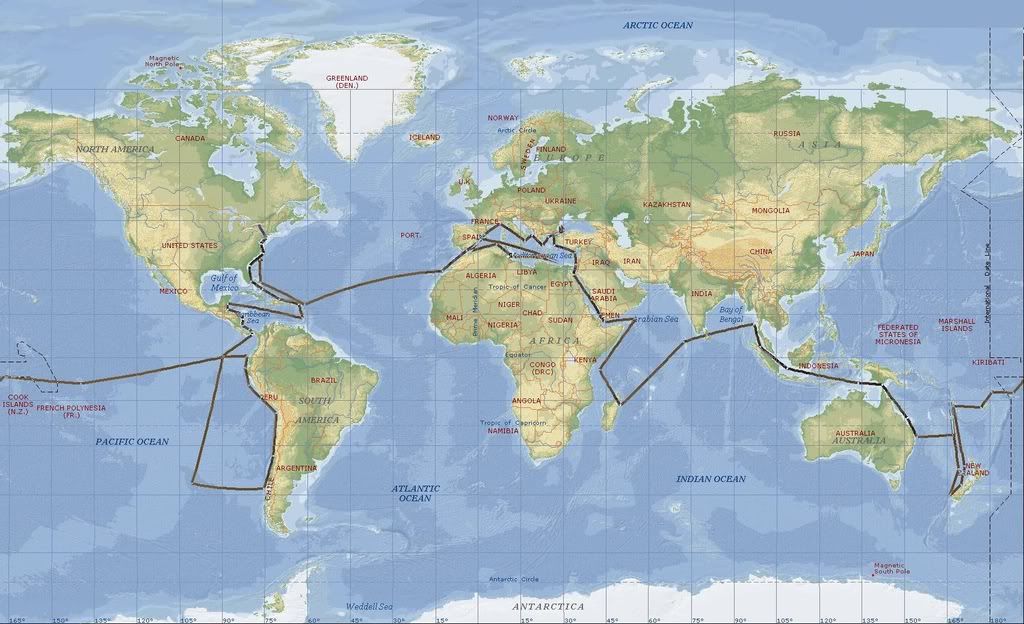
 We arrived in Bonaire ,on August 15th, the first of the Netherlands Antilles, which counts three islands in the area, Bonaire, Curacao and Aruba. We sailed smoothly from the Aves in Venezuela on a 45 nautical miles ride.
Sunday, August 16, 2009
Arrived in the Netherlands Antilles, Bonaire
We arrived in Bonaire ,on August 15th, the first of the Netherlands Antilles, which counts three islands in the area, Bonaire, Curacao and Aruba. We sailed smoothly from the Aves in Venezuela on a 45 nautical miles ride.
In the Venezuelan Islands.
 In the Antilles the distances between each island could be crossed in few hours during the day but the path that we are now travelling implies much longer distances that requires night crossings to ensure we arrive at destination during daylight. So far our night passages always consisted in a miserable battle against the wind and the waves in the dark and, most of the time, motoring since Chocobo cannot sail upwind efficiently. Now that we sail west this is a whole different story though. With the wind and the wave from behind this makes the sailing extremely pleasant and, as if it wasn’t enough, the weather is just perfect with 15 to 20 knots winds and a clear sky offering us flamboyant red sunsets. But for this the credit goes entirely to Danielle, our chef navigator, who for the past two weeks monitors the evolution of the weather systems three times a day and chose our crossing window with a surgical precision. Having nice weather during our crossings had nothing to do with chance but was in fact the result of Danielle’s zeal who spent hours analyzing the weather data from at least three different sources and then planned our crossings carefully.


Until now we visited three groups of islands, Los Testigos, La Blanquia and Los Roques. We stopped in the first group only to spend the night before moving on. The place was pretty but we wanted to keep going. At La Blanquia we stopped only for the day and left the same night toward Los Roques. Over there it is the real vacations. Its almost white sand beaches and its inhabited islands make of Los Roques a vacation place that the Venezuelans and other tourists take advantage plenty and we are no exceptions. Yesterday we stopped at an Island where only one other boat was anchored. In front of us laid a long sand beach and on our side, at about 300fts, was a large coral reef. We decided to take the day to relax while finishing the last shade cover that we are making to keep the cockpit cool. We first started in the morning by installing the rails on which the shade attaches and then we put on our masks and fins and swam to the beach about 450fts from the boat. Danielle thought that we do not exercise enough so she left at good speed and swam all the way to the beach with me dragging behind. Swimming 450fts even with fins is not obvious when we spend most of our time on a 40ft boat! I really miss my Tae Kwon Do classes! After taking some sand on the beach for our collection we swam to the coral reef and spent about an hour in the middle of multicolor fishes, which for the most part don’t seem to be bothered by our presence. Danielle would like to be able to touch the small silver fishes swimming in a school of a few thousands but they are not really the affectionate type and are very good at avoiding her hand in a synchronized dance. Once back on the boat we ate and then resume our work on the shade until we were again too hot and jumped in the water again. We returned to the different kind of parrot fishes, the school of purple fishes that I forgot the name and all the other ones as colorful as the next one. Those snorkeling sessions are really fun. A coral reef can easily host 20 to 50 different species of fish and shellfish not to mention the coral itself. It is easy to spend one or two hours swimming in the middle of this natural fish tank without getting bored. Finally we finished the shade just after a flamboyant red sunset and finished the day with a good bottle of wine.
 I finally completed the installation of the two remaining solar panels, which completes this long awaited project and gives us close to three times more electricity than before. A big thank you to Richard on “Marie Galante II” who gave me a good help to install the two center panels and to run all the wires in the boat. The reason I am talking so often about those panels is because the impact on our quality of life is major. Since we installed the new panels we have almost no restrictions anymore on the electricity usage. Those of you who live on a boat I am certain know what I am talking about. Practically, this means we can now produce between 25 and 40 gallons of water per day, use our computers as often as we want and power our refrigerator, which now works overtime under the heat of the tropics. The water we make allows us to take two showers each per day, to rinse with fresh water after our multiple swims and is still enough for washing the dishes and the laundry. As I write these lines on my 90W computer Danielle plays on the Playstation II with the 100W television and the 50W speakers. With all this there is still enough current to charge the batteries! To get the same amount of daily electricity without the panels we would have to run the engines for at least two hours per day, which is not only costly but extremely noisy and damageable for the engines.
If you like the technical stuff here’s a detailed description of the project in question. Before, we had four Siemens 75W solar panels for a total power of 300W and a conventional charge controller Trace-40C. We added 2 new 130W Kyocera solar panels and two 65W panels for a total additional power of 390W, which gives us a total nominal power of 690W. Our existing controller had a problem and I preferred to change it. Also I couldn’t connect the old panels in parallel with the new ones on the same unit so I needed two units in parallel, one for each group of panels. I chose the controller “Solar Boost 50” from Blue Sky, which is more expensive but also boosts the current by 20% by lowering the 17V voltage of the panels down to about 14V to the batteries. With the 20% boost this gives us the equivalent of 830W of solar panel with a conventional controller! I also changed the wires for the old panels in order to reduce the power dissipation in the old undersized wires. Even by bringing the controllers as close as possible to the batteries the run between the solar panels and the batteries is still over 60fts hence a total distance of 120fts since the current must go back through the negative wire. For this I used AWG-6 gauge, 7 strands zinc platted copper wire guarantying less than 3% of power loss. Practically, we get between 35A and 40A of charging current for most of the day. I haven’t measured the total charge we get but based on my estimate I’d say it is between 200 and 250 Amp-hour per day.
Arrived in Venezuela
 We arrived in the Venezuelan offshore islands of Los Testigos on August 2nd after a memorable 106 miles sail from Carriacou in Grenada. We left at the end of the afternoon, just before sunset, to arrive during daylight in these poorly charted islands. This was our first long sail with the wind from behind and it was delightful. After ten months of beating upwind it was a real treat to just fly smoothly west along with the wind.
Friday, July 31, 2009
Getting prepared to go west.
 After a month in Grenada we are now almost ready to leave to continue our trip west. This may not be obvious at first but we are now getting ready to cross the no-return point of our trip. Until now it was always possible to turn and sail back home since the wind is mainly coming from east. However, once we leave Grenada it becomes significantly harder to go back east hence making it a decisive point in our trip where if we go west we have to go all around the earth to come back home! I don’t know for you guys but it gives us a bit of a tingle.
Our plan is to sail from Carriacou, where we came back to get aluminum bars for the solar panels, to the offshore islands of Venezuela and eventually reach the island of Curacao. The tricky part here is Venezuela. The coast between the continent and the large island of Margarita has the bad reputation of not being the safest place for the sailors and the temptation is to simply jump directly to Curacao on a three day trip and to skip entirely the Venezuelan territory. However, Venezuela has many islands that are pretty far from the continental coast and are beautiful little paradises. To go there we need to go first to Margarita in order to clear the customs and then risking some unwelcomed encounters. However, last week we went to the Venezuelan embassy in St-George’s, Grenada and found out that we can get a visa at the embassy that allows us to go to the offshore islands without clearing the customs in Margarita as long as we still report to the local authorities at each island, which is mandatory even when you clear the customs. This makes our trip much simpler and much nicer.
We already installed two of our four new solar panels and with the new controllers/boosters we doubled our charging capability, which now makes our life much easier. We will install the two small ones that remain as soon as we have a chance along the way. The places we go now are going to be almost inhabited so we don’t expect to have Internet and we don’t know when we will be able to post again. You can always follow our position by clicking on the “Where we are” button at the top of the page, which is the most up-to-date position report. Remember that the map on the left side of the page requires an internet access to be update and is likely not showing our latest position. Provisioning in Grenada was very easy so we filled up the boat with everything we need for the next three weeks until we reach Curacao. We are now getting very anxious about our backpack trip to Peru. We still don’t speak Spanish so it will be quite interesting how we will deal with that!
Thursday, July 23, 2009
The life aboard Chocobo
 As sailing goes during the past few weeks we’ve been relatively idle mainly because we were waiting for our new solar panels to arrive, which they did last Monday thanks to Wilburt Wahl in Clayton, NY who went through all the trouble of shipping them to us here in Grenada since the panel company would not ship outside the USA. Of course we had to bring them back to the boat with “our car”. Four solar panels, it takes a lot of room in a 10 ft inflatable boat as you can see. Now and for the next week we will be busy installing the panels and will depart as soon as we can after to head toward the Island of Curacao where we plan to haul out the boat for three months, the first two while we go backpacking in Peru and Bolivia.
So, for the past couple of weeks we’ve been just living a normal life on our boat and since we haven’t talked much in this blog about what it looks like to live on a boat I will dedicate this post on our more mundane day to day life. Well, we may say mundane but believe me it is quite different than what you may be used to do if you live on land. First it is important to understand that we are not in a long vacation in the south islands but we live on our boat and our backyard changes almost every week. In vacation you usually don’t worry about stuff like grocery, laundry or engine oil changes, but we sure do. Second, the heat down here is such that we just cannot function as fast as we would like and this is called “the island time”. Time is just not the same here and what we do in a day here we used to achieve the same amount of work in about two or three hours back home. Therefore, we may not have a full time job but we are busy and always trying to do something, even if it means working at snail speed!
 I’ve already talked about the numerous local farmers markets so I won’t elaborate again. However, acquiring food and taking it to the boat is one our main activities. At home we would just stop after work at the Loblaw superstore and buy pretty much everything we need for the next few days in about 20 minutes. We would then pack the car and drive back home where the car is parked in a stable and firm driveway in front of the double door garage. Well on Chocobo things are slightly different. For one thing, you can’t find everything at the same location and in many places, we went, the “supermarket” was not bigger than what we call a convenience store back home. Because of this, shopping grocery takes easily an entire day and often two! The shopping begins by lowering the dinghy, which is attached on the back of the boat. We will take our grocery bags with us since, especially in the French islands, they often don’t have bags or if they do they are small plastic bags not convenient for walking long distances. We then motor to the most convenient dock we can find and where most of the time we can “legally” attach our inflatable and then walk to the market. We go to the different stalls at the market asking for stuff and dealing down the prices when we think they give us the “tourist price” and then go back to the dinghy with our bags. If there’s water in the bottom of the dinghy I will take the time to dry it to avoid our grocery to get wet. Then we motor back to the boat. Here, if we are lucky there would be no waves. Often though Danielle would go on the boat and I will pass her each bag while trying to stand in the rocking inflatable. Because of the different bugs using the fruits to board our boat like illegal aliens in the containers back home, we then have to clean each and every item with water and soap like you would do with the dishes. But then the real fun begins. Because of the extreme heat we cannot keep the fruits on the counter and we have to fit them all in our tiny vertical fridge. Nothing more fun than opening the top door and emptying half of it to get to the pot of juice!
Here in Grenada we are spoiled by the fact that fruits and vegetables are relatively cheap. All the food you see on that picture cost us $80.00EC or $30.00US. You can easily eat healthy here! Also look carefully at the picture and yes that price includes the large bottle of pure vanilla you see behind one of the pineapple. We love the Spice Island of Grenada.
 Like I said many times the heat is unbearable most of the time for Canadians like us and we decided to make shade covers that we would spread on three sides of the cockpit. Here Danielle is busy assembling one of the panels using our new sewing machine that can sow 8 layers of thick canvas without a blink! She better do the job right because Nemo is watching her carefully!
Taking care of the boat is another of the main tasks keeping us busy. This includes the mechanical repairs of whatever piece of equipment that decided to leave the very unstable working state to join the very stable non-working state that every single piece of equipment on board seems to be dreaming to achieve. But this also includes cleaning and tidying the boat and THIS is not an easy task. It is just absolutely incredible how a single of Danielle’s long curly hair manages to gather all kind of stuff and create its how dirt ball. I think that every hair when it falls must exclaim itself “Yeeesss! Finally free to take over that boat. If I manage to accumulate enough dirt I will be able to use up all the space and then kick these two big guys out! Wouha-ha-ha-ha!” But their plan doesn’t account for the powerful Dirt Devil ™ that we bought in the USA and that sucks all the hairs with Napoleonic ambitions in a jiffy.
But the chores on board go much further than vacuum cleaning and we still have to cook, clean the dishes and do the laundry. The fact is that we eat almost three meals a day on board hence generating an incredible amount of dirty dishes making us regret our nice and powerful dishwasher we had back home. I also suspect that the dishes have a similar plot than the hairs for taking over the boat!
Cleaning the dishes is not just tedious but it uses a fair amount of water and so do our showers, toilet flushings and laundry cleaning. The latter being the top contender in the contest of who uses all our precious water. And fresh water is precious on a boat since to obtain it we have to use the energy hungry watermaker every day for a good three hours and often more. This drains our batteries down and then we have to run either the AC generator or the engines to charge the batteries up. This is actually one of the main reasons of adding new solar panels to rely more on the sun instead of diesel to charge our batteries.
Scares water obviously means interesting showers especially along the American East coast when the weather was not as hot as down here in the Antilles. You see, on land the normal shower process usually starts by opening the tap, waiting for the hot water to come and then adjusting the regulator to have the perfect temperature before putting our temperature sensitive skin under the flow of water rushing at full pressure. Doing that on a boat, even with the very low pressure, would cost almost 2 gallons of water, which is about what we need to take a complete shower! Do you really think we can afford such a luxury? Hell no, we get in the shower, take a big breath and then turn the tap. “Aaarrrrghhhhhhhh! Hoooo-hooooo-hooooo Oh-my-god-I-am-gonna-die!!!!!” We just wet ourselves and quickly turn the tap off, soap ourselves in a rush to profit of the water that is still on our skin and then turn the tap on only to rinse our entire body with the equivalent of two glasses of water! If we are lucky during the second half of the rinse cycle we may have some hot water finally coming out. Of course, the trick is to jump in the shower immediately after the other came out and get the hot water immediately! The good news is that for the past few months we are just happy to take a shower using only the cold water, which is hot anyway like everything else down here.
Well after going to the market, cooking the meals, washing the dishes, cleaning the boat and then having a cold shower we are good to go to bed. If we are not too exhausted we can maybe spend a bit of time thinking about a visit of the island we could do someday once we got the time! There are quite a few other day to day activities I could tell you but I’ll have to keep that for another post since this one is getting seriously too long.
Sunday, July 12, 2009
St-George, Grenada; we are really spoiled.
 We are now in St-George, Grenada for almost two weeks and after visiting the Island and tidying the boat after Claudette’s departure we are now waiting for our new solar panels two arrive from USA. After ten months living on the boat we realized that we just didn’t have enough charging capability and that more power was required. We may have decided to live on a boat but this doesn’t mean we have to live miserably for four year! We want to be able to use our computer, watch movies, make tons of water and enjoy all the other small pleasures of life that the precious electrons can provide. While waiting we visited the gorgeous town of St-George, which has by far the most beautiful waterfront we saw in this trip so far. This morning we were taking a quiet Sunday morning walk through the streets of St-George and it just struck us how graceful life was with us. Think of it, how many times did you wake up in the morning and decided to take a walk on the boardwalk of St-George in Grenada? With the sun rising up over our head, we were admiring the unique architecture of the city with buildings standing here probably for almost a century while walking along the fishing boats that their owners attached near the concrete wall on that Dominican day. I mean, let’s face it; we are spoiled!
 I took this picture to show you what I consider the most efficient bus system I’ve seen in my life and that would make all the morons planning the public transportations systems in Canada look like a bunch of wannabe. This van can sit about 10 passengers and follow a predetermined route with assigned bus stops for a fixed price of $2.50EC or a bit less than $1US. Each bus has two guys; a driver and a doorman whose role is to pick people up from the street. What makes the system so efficient is the simplest principle of capitalism; the buses are privately owned. This means that if the driver-owner doesn’t pick-up passengers he doesn’t make money. No need to say that the guys are VERY good and motivated at getting people on the streets to jump on their bus and not on the next one. Being in the islands the rules are meant to be bent and let’s say that they may not always pick and drop their passengers at the designated locations hence increasing the number of passengers they get! Also, I don’t know how many buses are allowed per route but there are so many of them that when we asked in Nevis, where they have the same system, how long it usually takes for the bus to pass the lady simply answered; often enough! Well here in St-George, the longest we waited was 20 seconds and that’s because it was a very quiet day. Normally, and I am not kidding here, we don’t even have the time to reach the street that there is already a bus stopped and waving at us to get in. Seriously, if our system at home was that cheap and efficient do you really think people would stick to their polluting cars?
 Yesterday we had a very nice visit from an enormous manta ray that went swimming just by Chocobo. Danielle saw it first and said, “Roger there is something big over there in the water!” We quickly got up and saw the distinct movement of the ray. Here we are jumping all over to try to get the camera, which obviously isn’t at its usual spot. After a quick survey of the cabin and avoiding hitting my head on the numerous hazards hanging everywhere on a boat just waiting to meet the highest extension of our body, I found it and ran back in the cockpit and of course she was already swimming away to our great despair. But then, probably because she had thirst for fame and wanted to be seen on the Internet, she turned back and went swimming just a few inches from the boat in a slow and graceful glide at the surface of the water. Not something we can see often even in these waters; we are really spoiled.
.
.
.
 After a while away from home we come to crave some of the food we used to have back in the cold country. Here in St-George we were happy to discover an IGA supermarket, which is a large grocery chain in Canada. Not only this was a known store but they also have the food we use to have back home, such as fresh mushrooms, beef, cereals in large variety, cold cuts and fresh milk! Wow! We were like two kids in a Toys-R-Us. We then decided to pay ourselves a real treat; a fondue with all the ingredients we use to eat at home. Thus we bough salad dressing and sour cream for the sauces and broccoli, cauliflower, fresh mushrooms and a real authentic beef steak! You may laugh at this list of ingredient but I challenge you to find them down here, especially the mushrooms. I don’t know why but they just don’t have them in the Antilles they just have the despicable canned mushrooms. A mushroom just needs some manure, humidity and dark to grow, I can’t believe they don’t have that here! Any how we had a very good meal and while at it we went for the ultimate treat on a boat as we turned on the air conditioning during the whole meal. Now we are really spoiled!
Wednesday, July 1, 2009
Many visits in Grenada


On the island of Carriacou, just north of the main island of Grenada, we visited this family boat factory where father and sons build local wooden boat by hand passing their skills from one generation to another. Everything is made here on site with some local woods as well as many imported essences. The visit here was short but this is the kind of things that you have to see once in your lifetime.


Waterfalls in the islands are one of the main attractions for tourists and we didn’t escape it either but this time we brought our swimming suit. The water, flowing from the mountains, was actually pretty cool compare to the sea water we usual swim in, which is at 87°F. But what took us a bit by surprise was how much less we float in fresh water compare to salt water. After 6 months of swimming in salt water we had to wiggle quite a bit more to stay afloat!


This is a spice house and this is the kind of place that if you don’t travel you’ll never see something like this. In this building the workers, paid about $8 per day, will work on preparing different spices before they get shipped to the processing plan. The ladies here are extracting the nuts from the nutmeg fruit as well as a red substance covering the nuts called mace, which is also a hot spice. They also process clove, chocolate, pimento, cinnamon and some other leafs I don’t remember the names. In the large racks outside you can see the cocoa drying and they can push the wheeled racks under the house to protect the seeds from the rain.


Here, like in the spice house, we had the impression of travelling 80 years back in time in this nutmeg processing plan. They would take the nutmeg nuts, dry them on those large wooden racks for a few days then crack them open and extract the nuts that would be sold, among other things, to spice companies. Nutmegs and many other farm products were a large industry in Grenada before the hurricane Yvan stroke the island in 2004 and destroyed nearly 80% of the trees. A nutmeg tree takes apparently around 20 years before producing quality nuts, so you can imagine that this industry is not about to be back on its feet before long here.


We went to visit this little fresh water pond called “Grand Etang”, which is in the hole of a dead volcano. The pond was not as interesting as all these kids who were there with their parents and who had a good time getting filmed on our handycam and seeing themselves back on the LCD monitor of the camera. Claudette here couldn’t resist getting her picture with our guide Raymond after the visit.
Subscribe to:
Posts (Atom)